
Now Reading: AI Investing for Beginners: The Complete Guide (2026)
-
01
AI Investing for Beginners: The Complete Guide (2026)

Last Updated: May 2026 · 10 min read · Investing Basics
Key Takeaways
- Global corporate AI investment reached $581.7 billion in 2025 — up 130% year over year, according to Stanford HAI’s 2026 AI Index Report
- AI is projected to grow into a $3.5 trillion market by 2033 at a 30.6% compound annual growth rate
- There are four main ways to invest in AI as a beginner: broad technology ETFs, dedicated AI ETFs, individual AI stocks, and AI infrastructure companies
- Most beginner mistakes in AI investing are not about picking the wrong stock — they are about entering too late, paying too much in fees, or misunderstanding what they actually own
- You do not need a large amount of money to start — fractional shares allow AI ETF investments from as little as $1
AI investing for beginners means gaining financial exposure to the companies building, powering, or benefiting from artificial intelligence — without needing to pick individual winners or predict which technology will dominate. The most practical entry points are broad technology ETFs that include AI companies as top holdings, dedicated AI-focused ETFs, or individual shares of established AI infrastructure companies like NVIDIA or TSMC. You can start with as little as $100. The single most important decision is not which specific company to buy — it is understanding what you are actually buying and why.
Why AI Investing Matters Right Now
Artificial intelligence is not a future technology. It is an active, measurable investment theme generating real revenue, right now, for the companies building it.
Global corporate AI investment reached $581.7 billion in 2025, more than doubling in a single year, according to Stanford HAI’s 2026 AI Index Report. Hyperscaler AI capital expenditure hit $400 billion in 2025 and is projected to exceed $500 billion in 2026, according to Goldman Sachs. The AI market itself is projected to grow from approximately $391 billion in 2025 to $3.5 trillion by 2033 — a 30.6% compound annual growth rate that dwarfs most other investment categories.
These numbers matter to a beginner investor for one specific reason: the infrastructure supporting that growth is already being built, funded by signed contracts, and generating measurable revenue for the companies supplying it. This is not speculative technology. It is capital expenditure that is already on the books.
The question for a beginner is not whether AI is a real investment theme. It clearly is. The question is how to get exposure to it intelligently — without overpaying, without misunderstanding what you own, and without making the timing mistakes that most retail investors consistently repeat.
The 4 Ways Beginners Can Invest in AI
There is no single right way to invest in AI. There are four main approaches, each with different risk levels, complexity, and expected behavior.
1. Broad Technology ETFs
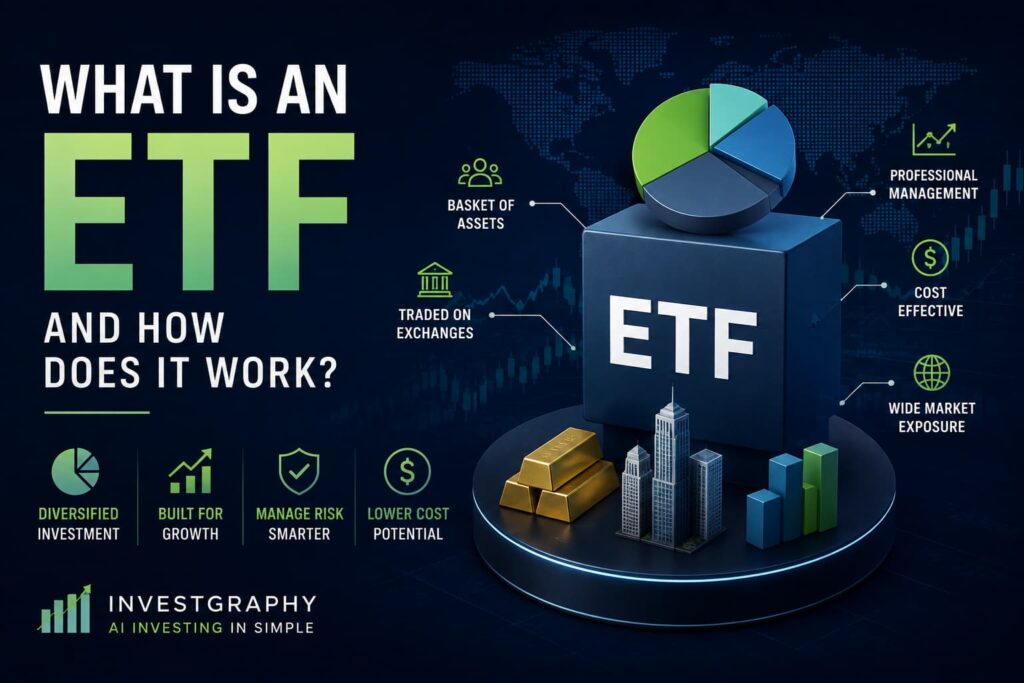
A broad technology ETF like QQQM tracks the NASDAQ 100 — the 100 largest non-financial technology companies. It includes NVIDIA, Microsoft, Alphabet, Meta, and Amazon as top holdings, giving you significant AI exposure without concentrating in a single company or theme. The expense ratio is 0.15%, and over the past year it returned 33.41%.
This is the most practical starting point for most beginners. You get AI exposure through the companies already dominating the sector, with diversification across 100 companies cushioning any single company’s poor performance. Even VOO — a plain S&P 500 fund — holds NVIDIA, Apple, and Microsoft as its top three positions, meaning almost any broad US market fund already contains meaningful AI exposure.
→ See: Best AI ETFs for Beginners in 2026 and S&P 500 vs AI ETFs — Which Is Better for Beginners?
2. Dedicated AI ETFs
Funds like AIQ, BOTZ, ARTY, and CHAT focus specifically on AI and robotics companies rather than broad technology. They give you more targeted exposure — but with higher expense ratios, fewer holdings, and in some cases weaker long-term performance records compared to broader funds.
BOTZ, for example, concentrates in robotics and AI hardware with roughly 50 holdings — more specialist, more volatile, and with a five-year annualized return of 0.69% compared to QQQM’s 13.10% over the same period.
→ See: QQQM vs BOTZ — Which AI ETF Is Better for Beginners?
3. Individual AI Stocks
Buying individual companies like NVIDIA, TSMC, Microsoft, or AMD directly gives you concentrated exposure to specific parts of the AI ecosystem. The potential upside is higher — but so is the risk. NVIDIA reported $81.6 billion in a single quarter ending April 2026 — extraordinary by any measure — but its stock price already reflects significant expected future growth. Buying a great company and buying it at a good price are two separate decisions.
For most beginners, individual stocks work best as a secondary position once you have established a diversified core holding in an ETF.
→ See: What Is NVIDIA Stock and Why Do AI Investors Care? and NVIDIA vs AMD — What Is the Difference for AI Investors?
4. AI Infrastructure Companies
The picks-and-shovels layer of AI — chip manufacturers, data center operators, power suppliers, and cooling systems companies — is where most institutional capital has actually concentrated. TSMC, which manufactures 72% of the world’s advanced chips, generated $122.9 billion in revenue in 2025. Energy companies supplying power to AI data centers are signing 20-year contracts directly with Microsoft, Google, and Amazon.
These companies do not make headlines the way AI apps do. But they are the physical foundation that every AI product depends on.
→ See: Why AI Money Isn’t in the App — It’s in the Infrastructure, The Real Winners of Every Tech Boom Sell the Shovels, and Why AI Runs on Electricity — The Energy Stocks Nobody Talks About
5 Things Every Beginner Must Understand Before Investing in AI
These five concepts separate beginners who make informed decisions from those who buy based on headlines and regret it later.
1. Expense ratios compound over time
The fee difference between a 0.03% expense ratio fund and a 0.68% fund sounds negligible. On $10,000 over 20 years it is not. Even a 0.5% annual fee difference results in thousands of dollars less at retirement. Always check what you are paying before you buy.
→ See: What Is an ETF and How Does It Work?
2. The crowd buys too late
By the time an AI stock becomes a mainstream headline, institutional investors have usually already built their positions. Retail investors enter based on fear of missing out — often near the top of a rally. In 2025, retail investor activity was 50% higher than 2024, with most of it concentrated in AI stocks that had already run significantly.
→ See: Why The Crowd Always Buys the Headline Too Late
3. Infrastructure beats apps for durable returns
Consumer AI apps compete on price and features — driving margins down. Infrastructure companies — chip designers, data centers, power suppliers — benefit from every new AI app that launches, regardless of which one wins. $650 billion in hyperscaler capital expenditure in 2026 flows to the infrastructure layer, not to the apps.
→ See: Why AI Money Isn’t in the App — It’s in the Infrastructure
4. Semiconductors are the physical foundation of everything
Every AI model runs on chips. NVIDIA dominates the AI accelerator market with over 80% share. TSMC manufactures those chips with 72% of global advanced foundry market share. Understanding the semiconductor supply chain is the single most important technical foundation for evaluating any AI investment claim.
→ See: What Is a Semiconductor and Why Does AI Need It?
5. Time matters more than timing
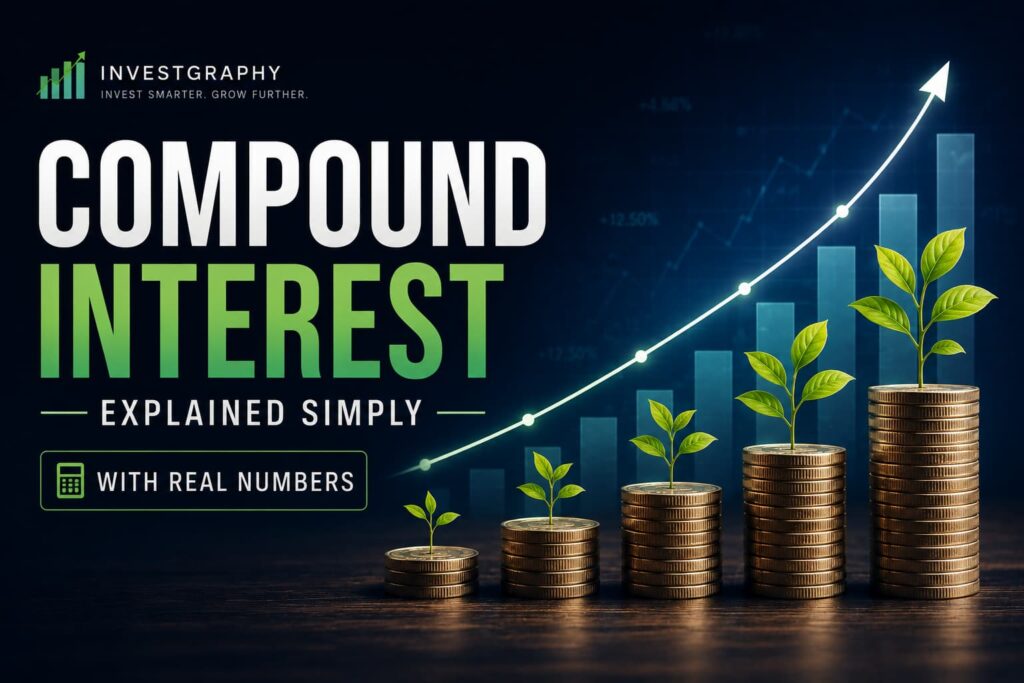
A 25-year-old investing $200 per month at a 7% annual return accumulates nearly $500,000 by age 65. A 35-year-old doing the exact same thing accumulates only around $250,000. The $250,000 gap comes almost entirely from ten additional years of compounding — not from picking better investments.
→ See: Compound Interest Explained Simply — With Real Numbers
How to Actually Start — Step by Step
Getting started with AI investing involves four practical steps that most beginners can complete in under an hour.
Step 1 — Open a Brokerage Account
Fidelity, Charles Schwab, and Robinhood all offer commission-free trading, no account minimum, and fractional shares. Fractional shares allow you to buy any dollar amount of any fund or stock, regardless of its share price.
Step 2 — Deposit Your Starting Amount
You do not need thousands of dollars. Start with whatever you have available — $50, $100, $500. The specific amount matters less than the habit of starting.
Step 3 — Buy a Broad Fund First
For most beginners, a single broad technology ETF is the clearest first purchase. It gives you diversified AI exposure without requiring you to evaluate individual companies. Once you understand what you own and why, you can add more targeted positions.
Step 4 — Invest Consistently
Set a fixed amount to invest every month, regardless of what the market is doing. Dollar-cost averaging — investing the same amount at regular intervals — removes the pressure of trying to time your entry and reduces the emotional impact of short-term price swings.
→ See: How to Invest in AI With $100 — Step by Step and What Is Dollar-Cost Averaging and Does It Actually Work for AI Stocks?
Understanding What You Own — The AI Stack
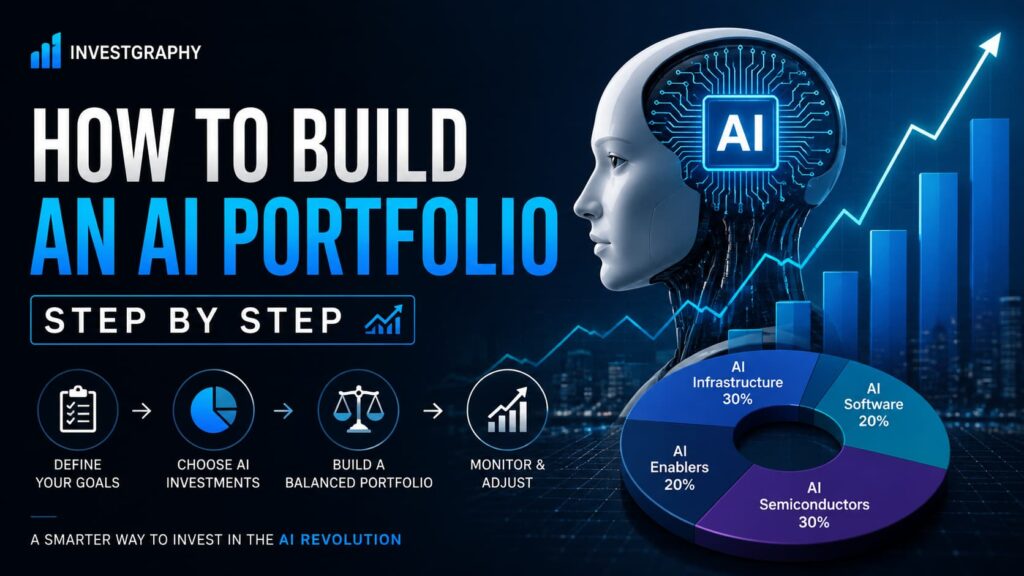
One of the clearest frameworks for a beginner is thinking about the AI investment opportunity in layers — what investors sometimes call the AI stack. Each layer represents a different part of the ecosystem, a different risk profile, and different kinds of companies.
The Chip Layer
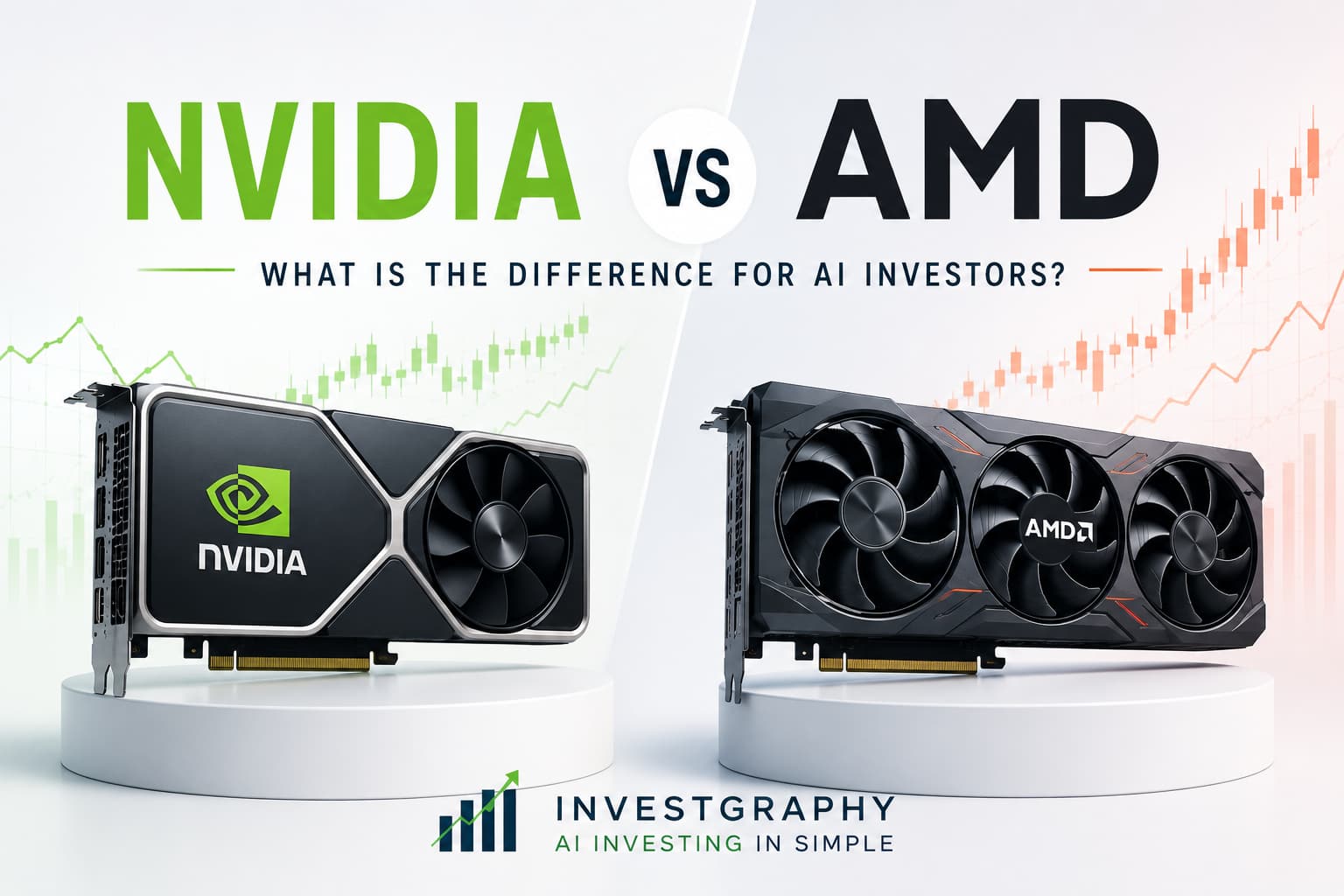
NVIDIA designs the GPUs every AI model runs on. TSMC manufactures them. AMD is the credible but distant second in AI chips. This is the most fundamental layer — if you own QQQM, you already own NVIDIA as its largest position.
The Infrastructure Layer
Data centers, power systems, and cooling equipment. Amazon, Microsoft, and Google are spending hundreds of billions building this layer. The companies supplying those builds — GE Vernova, Vertiv, Eaton, Constellation Energy — are the picks-and-shovels plays of the AI buildout.
The Model Layer
The AI models themselves: ChatGPT, Gemini, Claude, Llama. Most of the companies building these models are not publicly listed, or trade at valuations that fully reflect expected success. Microsoft’s investment in OpenAI gives VOO and QQQM holders indirect exposure to this layer.
The Application Layer
The apps and services built on top of AI models. This is the most competitive, lowest-margin layer. This is also where most beginner investors instinctively focus, and where the least institutional capital has concentrated.
Understanding which layer you are buying into when you purchase any AI-related investment is the most useful analytical habit you can develop.
Your Complete Reading Path on Investgraphy
Every article below expands one section of this guide into a full, detailed breakdown. Work through them in order if you are starting from scratch, or jump to the topic most relevant to where you are right now.
Start Here — Foundations
- What Is an ETF and How Does It Work?
- What Is a Semiconductor and Why Does AI Need It?
- Compound Interest Explained Simply — With Real Numbers
- How to Read a Stock Chart for the First Time
AI ETFs — Choosing Your First Fund
- Best AI ETFs for Beginners in 2026
- QQQM vs BOTZ — Which AI ETF Is Better for Beginners?
- S&P 500 vs AI ETFs — Which Is Better for Beginners?
AI Stocks — Understanding Individual Companies
- What Is NVIDIA Stock and Why Do AI Investors Care?
- NVIDIA vs AMD — What Is the Difference for AI Investors?
Strategy — How to Actually Invest
- How to Invest in AI With $100 — Step by Step
- What Is Dollar-Cost Averaging and Does It Actually Work?
- Best Stock Tracking Apps for Beginner AI Investors
The Bigger Picture — Where the Money Goes
- Why AI Money Isn’t in the App — It’s in the Infrastructure
- The Real Winners of Every Tech Boom Sell the Shovels
- Why AI Runs on Electricity — The Energy Stocks Nobody Talks About
- Why The Crowd Always Buys the Headline Too Late
FAQ
What is AI investing in simple terms?
AI investing means buying shares in companies that design, build, power, or significantly benefit from artificial intelligence technology. This includes chip designers like NVIDIA, cloud providers like Microsoft and Amazon, semiconductor manufacturers like TSMC, and funds that hold baskets of these companies. You do not need to understand how AI works technically to invest in the companies profiting from its growth — you need to understand what those companies do and how they make money.
How much money do I need to start investing in AI?
You can start with as little as $1. Most major US brokerages — including Fidelity, Charles Schwab, and Robinhood — offer fractional shares, which allow you to invest any dollar amount in any stock or ETF regardless of its share price. A $100 starting investment is a practical and achievable target for most beginners. The amount you start with matters far less than whether you invest consistently over time.
Is it too late to invest in AI in 2026?
The AI infrastructure buildout is still in early stages by most analyst measures. Hyperscaler capital expenditure is projected to exceed $500 billion in 2026, the semiconductor market is projected to grow from $792 billion in 2025 to nearly $975 billion in 2026, and Goldman Sachs projects $7.6 trillion in total AI infrastructure spend through 2031. Whether any specific investment is attractively priced at any given moment is a separate question that depends on valuation — but the structural growth thesis remains intact and well-funded. This is not financial advice — always research current valuations before investing.
What is the safest way for a beginner to invest in AI?
For most beginners, a low-cost broad technology ETF like QQQM or a standard S&P 500 fund like VOO — which already holds NVIDIA, Apple, and Microsoft as top positions — provides meaningful AI exposure with the diversification of dozens or hundreds of underlying companies. Diversified funds reduce the risk that any single company’s poor performance significantly damages your portfolio. They are not risk-free — all equity investments carry market risk — but they represent a more cautious starting point than concentrated individual stock positions.
Do I need to understand AI technology to invest in AI companies?
No. What you need to understand is not how large language models work — it is how the companies you invest in make money, who their customers are, how much those customers depend on them, and what could realistically disrupt that relationship. NVIDIA’s business model — designing the chips that every major AI company buys in enormous quantities — is understandable without knowing anything about neural network architecture. Understanding the business is what matters for investing, not the technology itself.
AI investing for beginners is not about finding the next hidden gem before anyone else does. That game is played by institutional investors with teams of analysts, proprietary data, and capital that dwarfs anything a retail investor can deploy.
What it is about is understanding the investment landscape clearly enough to make decisions that match your goals, your time horizon, and your tolerance for volatility — without being misled by headlines, overpaying in fees, or buying into things you do not understand.
Global corporate AI investment more than doubled in 2025. The infrastructure buildout is funded and running. The companies at the center of it are generating real, measurable, growing revenue. For a long-term beginner investor, the opportunity is real — and it does not require perfect timing to participate in it.
Start with one fund. Understand what it holds. Invest consistently. Read every article in the path above over the next few weeks. By the time you finish, you will understand the AI investing landscape better than most people who have been investing for years.
Want plain English AI investing breakdowns every week? Subscribe to the Investgraphy brief — free, five minutes, no hype.
This article is for educational and informational purposes only and does not constitute financial advice. All figures are sourced from Stanford HAI’s 2026 AI Index Report, Goldman Sachs, IDC, Gartner, and publicly available company disclosures as of May 2026. Investing involves risk including possible loss of principal. Past performance does not guarantee future results. Always conduct your own research and consult a qualified financial advisor before making investment decisions.
About the Author
Investgraphy Team — Independent AI investing education for self-directed beginners. No hype, no jargon, no financial advice.