
Now Reading: What Is a Semiconductor and Why Does AI Need It?
-
01
What Is a Semiconductor and Why Does AI Need It?

Last Updated: May 2026 · 5 min read · Investing Basics
Key Takeaways
- A semiconductor is a material that conducts electricity under certain conditions — the physical foundation of every chip powering AI
- The global semiconductor market reached approximately $792 billion in 2025 — driven primarily by AI demand
- TSMC manufactures 72% of the world’s advanced chips and reported $122.9 billion in revenue in 2025, up 31.6% year over year
- NVIDIA dominates over 80% of the AI accelerator market — its chips sit inside every major AI data center
- AI-related chip revenue at TSMC is forecast to grow at over 50% annually through 2029
A semiconductor is a material — typically silicon — that conducts electricity under certain conditions and acts as an insulator under others. This property makes it ideal for building the transistors that power computer chips. Every AI model, every smartphone, every modern electronic device runs on semiconductors. In 2025, the global semiconductor market reached approximately $792 billion. AI demand is now the primary driver of that growth — and it shows no signs of slowing.
What a Semiconductor Actually Is
The word semiconductor describes a physical property of certain materials. Pure silicon — the element found in sand — sits between a conductor like copper, which freely passes electricity, and an insulator like rubber, which blocks it entirely. With precise chemical engineering, silicon can be made to conduct or block electricity on demand.
That controllable property is what makes chips possible. A modern semiconductor chip contains billions of tiny transistors — microscopic switches that turn electrical signals on or off. By arranging billions of these switches in precise patterns, engineers can create processors capable of performing complex calculations at extraordinary speed.
The chip inside your phone contains roughly 16 billion transistors. An NVIDIA H100 GPU — the chip powering most AI data centers today — contains 80 billion transistors on a piece of silicon roughly the size of a credit card.
Why AI Is Completely Dependent on Semiconductors
Training an AI model requires performing billions of mathematical calculations simultaneously — over and over — for days or weeks at a time. Standard computer processors handle tasks sequentially. Chips designed for AI handle thousands of calculations in parallel.
NVIDIA’s GPU chips were originally designed for video game graphics, which also require massive parallel processing. The same architecture turned out to be exactly what AI training and inference demands. This is why NVIDIA became the dominant AI chip company almost overnight — it had already spent decades perfecting the parallel processing architecture that AI needed.
Today, 80% of the AI accelerator market belongs to NVIDIA. Every major AI model — ChatGPT, Google Gemini, Meta’s Llama — runs on NVIDIA chips during training. AI inference — the process of generating a response each time you interact with an AI tool — also depends overwhelmingly on NVIDIA hardware in commercial data centers.
High-performance computing, which includes AI-related workloads, now accounts for roughly 61% of TSMC’s revenue — up from 46% just two years ago. The shift from a general-purpose chip industry to one dominated by AI-specific demand happened faster than almost anyone predicted.
The Two Companies Every AI Investor Should Know
Understanding semiconductors as an investor comes down to understanding two companies above all others.
NVIDIA — the designer
NVIDIA designs the GPUs that power AI. It does not manufacture them. Its value lies in its chip architecture and its CUDA software ecosystem — the programming platform that almost all AI development tooling is built on. Switching away from NVIDIA hardware means rewriting enormous amounts of code, which is why its market dominance is so difficult to displace.
For fiscal year 2026, NVIDIA reported total revenue of $215.9 billion — up 65% year over year. Its most recent quarterly result, reported May 20, 2026, showed $81.6 billion in a single quarter with data center revenue of $75.2 billion.
TSMC — the manufacturer
Taiwan Semiconductor Manufacturing Company manufactures chips for NVIDIA, Apple, AMD, Qualcomm, and almost every other major chip designer in the world. It held 72% of the global foundry market share in the second half of 2025. Without TSMC, the chips NVIDIA designs simply could not be built at the scale the AI industry requires.
TSMC reported $122.9 billion in revenue for 2025 — up 31.6% year over year — and forecasts approximately 30% growth in 2026. Its AI accelerator revenue is projected to grow at over 50% annually through 2029. It is investing $165 billion to build five new fabrication facilities in Arizona alone, expanding manufacturing capacity closer to its largest customers.
The Semiconductor Supply Chain — Why It Matters to Investors
The semiconductor supply chain is one of the most complex and geographically concentrated in global industry. Understanding it helps investors understand the risks.
NVIDIA designs chips in California. TSMC manufactures them in Taiwan using equipment from ASML in the Netherlands — the only company that produces the extreme ultraviolet lithography machines needed to print the most advanced chips. The manufactured chips then travel to assembly and packaging facilities before landing in data centers operated by Amazon, Microsoft, and Google.
Every step in that chain is a potential bottleneck. TSMC’s concentration in Taiwan is the most discussed geopolitical risk in technology investing — a conflict in the Taiwan Strait would disrupt the supply of advanced chips for the entire global AI industry. The US government has acknowledged this explicitly, which is why TSMC is investing $165 billion in Arizona manufacturing capacity.
Export controls are a second real risk. The US government has restricted NVIDIA’s most advanced chip sales to China — a restriction that cost NVIDIA $4.5 billion in charges in Q1 fiscal 2026 alone.
What Beginners Can Do With This Knowledge
Semiconductor investing does not require picking the winning chip company. The semiconductor ETF SOXX holds 26 companies spanning chip designers, foundries, equipment manufacturers, and memory producers — with NVIDIA at 19.4%, TSMC at 11.6%, and Broadcom at 7.7%. Its expense ratio is 0.35%. It gives diversified exposure across the entire semiconductor supply chain without requiring conviction in any single company.
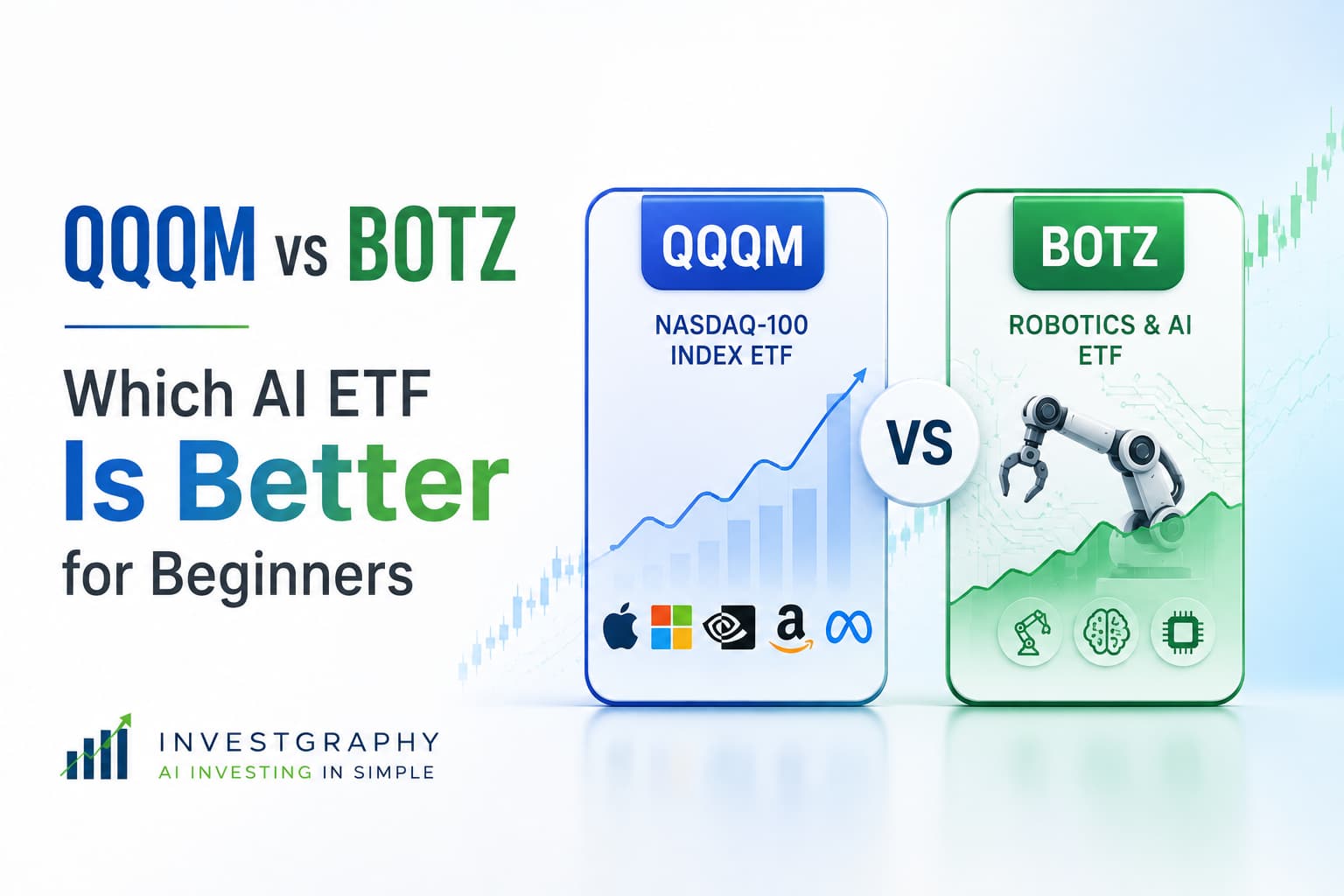
For a beginner who has already established a position in a broad technology fund like QQQM — which already includes NVIDIA as its largest holding — SOXX adds exposure to the manufacturing and equipment layers that QQQM does not cover as heavily.
Understanding what a semiconductor is, which companies sit at the critical nodes of its supply chain, and where the bottlenecks exist gives you a framework for evaluating every AI-related investment claim you will ever encounter. Almost all of them trace back to this layer.
FAQ
What is a semiconductor in simple terms?
A semiconductor is a material — usually silicon — that can be engineered to conduct or block electricity on demand. This property makes it ideal for building transistors, the microscopic switches inside computer chips. Every modern electronic device — from smartphones to AI data center servers — runs on chips made from semiconductor materials. The term is often used interchangeably with “chip” in investing contexts, though technically a semiconductor is the material and a chip is the finished product.
Why do AI companies need so many semiconductors?
AI model training requires performing billions of calculations simultaneously — a task that demands chips capable of massive parallel processing. A single AI training run for a large language model can require thousands of GPUs running continuously for weeks. As AI models become more powerful and more widely deployed, the demand for semiconductor chips grows with them. The IEA projects that AI-specific data center electricity demand will triple by 2030 — all of that compute runs on semiconductor chips.
What is TSMC and why is it important for AI investors?
TSMC — Taiwan Semiconductor Manufacturing Company — manufactures the majority of the world’s most advanced chips, including those designed by NVIDIA, Apple, and AMD. It held 72% of global foundry market share in 2025. Without TSMC’s advanced manufacturing processes, the chips powering AI data centers could not be produced at scale. This makes TSMC one of the most strategically critical companies in the global AI supply chain — and a company analysts increasingly view as a core AI infrastructure investment alongside NVIDIA.
Is the semiconductor industry a good investment for beginners?
The semiconductor industry is the physical foundation of AI — and AI is now the primary driver of semiconductor demand. The global market reached $792 billion in 2025 and is projected to approach $975 billion in 2026. For beginners, semiconductor ETFs like SOXX offer diversified exposure across chip designers, manufacturers, and equipment suppliers without requiring individual stock selection. As with all investments, valuations matter — always research current prices and consult a financial advisor before investing.
Conclusion
Every AI investment discussion eventually comes back to semiconductors. The chips, who designs them, who manufactures them, how many can be produced, and who controls the supply chain — these are the questions that determine where AI infrastructure money actually flows.
NVIDIA dominates the design layer. TSMC dominates the manufacturing layer. ASML controls the equipment that makes advanced manufacturing possible. Understanding those three nodes gives you the analytical foundation for evaluating almost any AI infrastructure investment.
The $792 billion semiconductor market in 2025 was built almost entirely on AI demand. The $975 billion projected for 2026 is being driven by the same force — and it is still accelerating.
Want this kind of foundation-building analysis every week? Subscribe to the Investgraphy brief — free, five minutes, no hype.
Disclaimer
This article is for educational and informational purposes only and does not constitute financial advice. All figures are sourced from TSMC earnings disclosures, NVIDIA SEC filings, KuCoin market analysis, IndexBox, and Zacks Investment Research as of May 2026. Investing involves risk including possible loss of principal. Always conduct your own research and consult a qualified financial advisor before making investment decisions.
About the Author
Investgraphy Team — Independent AI investing education for self-directed beginners. No hype, no jargon, no financial advice.