
Now Reading: NVIDIA vs AMD What Is the Difference for AI Investors?
-
01
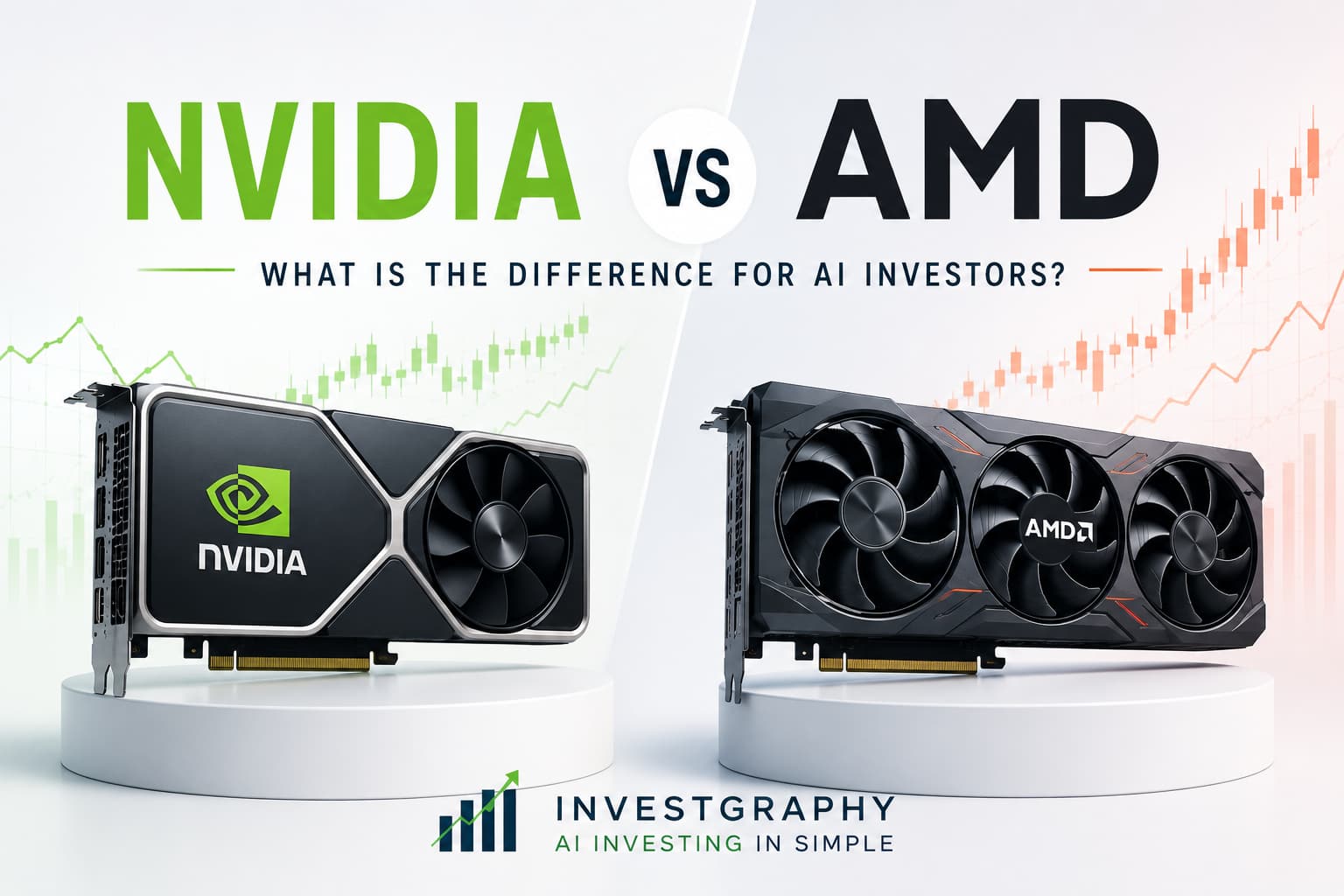
NVIDIA vs AMD What Is the Difference for AI Investors?

Key Takeaways
- NVIDIA holds approximately 80% of the AI accelerator market, with AMD at roughly 5 to 7%, but AMD’s AI chip revenue grew from near-zero to $7 to $8 billion in two years.
- NVIDIA’s data center revenue reached $193.7 billion in fiscal year 2026 versus AMD’s full-year 2025 data center revenue of $16.64 billion.
- OpenAI announced a partnership with AMD that includes taking up to a 10% stake in the company to secure supply of up to 6 gigawatts of GPUs.
- NVIDIA’s CUDA software platform remains the primary reason its market lead is difficult to displace. AMD’s ROCm has improved but still trails in real-world performance.
- AMD’s MI350 series has a genuine hardware advantage in memory capacity, making it competitive specifically for AI inference workloads rather than large-scale training.
NVIDIA dominates the AI chip market with roughly 80% share and $193.7 billion in fiscal 2026 data center revenue, built on its CUDA software ecosystem that took over a decade to develop. AMD is the clear and growing second option, with data center revenue reaching $16.64 billion in 2025 (up 32% year over year) driven by its Instinct MI300 and MI350 chips. For investors, NVIDIA represents the established leader with the wider moat, while AMD represents the higher-growth, higher-risk alternative gaining real traction in AI inference specifically.
The Scale Difference: Why It Matters First
Before comparing technology or strategy, the raw numbers need to be understood, because the gap between these two companies is enormous in absolute terms even as AMD grows quickly in relative terms.
NVIDIA holds approximately 80% of the AI accelerator market, with AMD at roughly 5–7% and NVIDIA reaching $193.7B in data center revenue for fiscal year 2026. In a single recent quarter, NVIDIA’s data center revenue reached approximately $75 billion. Conversely, AMD brought in $16.64B in full-year 2025 data center revenue, which is up 32% for all of 2025.
This means NVIDIA’s quarterly data center revenue alone is roughly four to five times larger than AMD’s entire annual data center business. AMD’s AI-specific GPU revenue, separated from its server CPU business, is estimated at $7 to $8 billion, meaning NVIDIA’s AI chip business is currently more than 20 times larger than AMD’s.
That gap is the single most important fact to understand before anything else in this comparison.
Why NVIDIA’s Lead Is Difficult to Close: The CUDA Moat
The gap between NVIDIA and AMD is not primarily about chip specifications. It is about software.
NVIDIA spent over a decade building CUDA, a software platform that lets developers write code optimised specifically for NVIDIA hardware. Nearly every major AI research framework, library, and tool was originally built and tested on CUDA. Switching to a different chip platform means rewriting and re-optimising enormous amounts of code, a real cost that goes beyond simply buying different hardware.
AMD’s answer is ROCm, its own open-source software platform, now on version 7. ROCm has genuinely improved, with day-zero support for major AI models and significant performance optimisation work over the past two years. Even so, independent benchmarking organizations note a visible CUDA vs ROCm performance gap based on SemiAnalysis benchmark data, finding that CUDA still delivers meaningfully better real-world performance on many workloads due to its software maturity, even when AMD’s raw hardware specifications look competitive on paper.
This is why NVIDIA maintains margins between 79% and 88% on its chips, while AMD’s margins sit between 64% and 68%. The software ecosystem, not just the silicon, is where much of NVIDIA’s pricing power comes from.
Where AMD Is Actually Competitive
AMD is not simply chasing NVIDIA across every category. It has built genuine advantages in specific areas, and investors should understand exactly where those advantages exist.
Memory capacity stands out as a core strength, as seen on the MI350X featuring 288GB HBM3e, which runs Llama 4 Maverick on 3 versus 5 GPUs compared to NVIDIA’s hardware. This is a real, measurable hardware advantage. For AI inference, the process of running an already-trained model to generate responses, more memory per chip means a large language model can run on fewer GPUs.
Focusing on inference workloads specifically, AMD has deliberately targeted its strategy here rather than competing head-on with NVIDIA in large-scale training, where CUDA’s advantage is strongest. Industry projections suggest inference will represent costly portions of compute infrastructure going forward, meaning AMD is targeting a large and fast-growing segment of the market, even while trailing significantly in overall scale.
Major customer wins support this direction. Microsoft Azure and Oracle Cloud have both adopted MI300X for workload diversification, not as a complete NVIDIA replacement, but as a genuine secondary supplier. Meta has run 100% of its live Llama 405B model traffic on MI300X chips, demonstrating that AMD’s hardware can handle serious production workloads at scale.
The OpenAI Deal That Changed the Conversation
In late 2025, AMD announced a partnership with OpenAI that materially changed how investors think about the company’s AI prospects. The details show a massive OpenAI 10% stake and 6 gigawatt AMD partnership deal designed to lock in future infrastructure pipeline.
This matters for two reasons. First, OpenAI is the largest and most closely watched AI company in the world. Its hardware decisions carry significant signaling value. A major OpenAI commitment to AMD chips suggests the largest AI labs see genuine value in diversifying away from total NVIDIA dependence, whether for cost, supply security, or negotiating leverage reasons.
Second, the scale is significant. 6 gigawatts of compute capacity is a substantial commitment, comparable in scale to some of the largest AI infrastructure deals announced by hyperscalers with NVIDIA. AMD CEO Lisa Su has targeted data center revenue scaling to tens of billions annually by 2027, and deals like this are central to that plan actually materialising.
The Structural Risk Both Companies Face
The more interesting long-term risk for NVIDIA may not be AMD at all. It is custom silicon.
Reports show Broadcom AI ASIC revenue topped $20B+ for FY2025, pointing to a rising custom silicon threat driven largely by designing custom chips for hyperscalers like Google. Amazon’s Trainium, Google’s TPU, and Microsoft’s Maia are all examples of large customers building chips specifically tailored to their own AI workloads, rather than buying general-purpose GPUs from either NVIDIA or AMD.
This is a different competitive threat than AMD presents. AMD competes with NVIDIA for the same customers using a similar product category: general-purpose AI accelerators. Custom silicon represents hyperscalers potentially reducing their need for either company’s chips for certain workloads entirely. Some analysts project an NVIDIA share decline from 87% down to 75% by 2026, not primarily because of AMD, but because of this broader diversification trend across the entire industry.
What This Means for a Beginner Investor
NVIDIA and AMD represent genuinely different risk profiles, not simply “the leader” and “the follower.”
NVIDIA is the established dominant player with the deepest software moat, the highest margins, and by far the largest revenue base. Its risk is less about losing its position to AMD specifically and more about whether its current valuation already reflects years of continued dominance, and about the slower-moving but real threat from custom silicon.
AMD is the higher-growth, higher-risk alternative. Its AI revenue is growing rapidly off a small base, it has secured genuinely significant customer commitments including the OpenAI partnership, and it has built real hardware advantages in memory capacity for inference workloads. The risk is that AMD remains a distant second in absolute scale, and a large portion of its future growth depends on execution that has not yet fully played out.
Neither company is inherently the “better” investment, they represent different bets on how the AI chip market evolves. A beginner who wants exposure to this theme without choosing between the two can consider a semiconductor ETF like SOXX, which holds positions in NVIDIA, AMD, and the broader chip supply chain simultaneously.
FAQ
Is AMD a real competitor to NVIDIA in AI chips?
Yes, but the scale gap remains enormous. AMD holds approximately 5 to 7% of the AI accelerator market versus NVIDIA’s roughly 80%. However, AMD’s AI GPU revenue has grown from near-zero to an estimated $7 to $8 billion in two years, and the company has secured significant customer commitments including a partnership with OpenAI. AMD is best understood as the credible number two option, particularly for AI inference workloads, rather than a company closing the overall gap with NVIDIA.
Why does NVIDIA have higher profit margins than AMD?
NVIDIA’s gross margins range from 79% to 88%, compared to AMD’s 64% to 68%, largely because of NVIDIA’s CUDA software ecosystem. CUDA has been developed over more than a decade and is deeply embedded in AI research and development tooling, giving NVIDIA pricing power that pure hardware specifications alone do not explain. AMD’s ROCm software platform has improved significantly but still trails CUDA in real-world performance maturity according to independent benchmarking.
What is the OpenAI and AMD partnership?
In late 2025, OpenAI announced a partnership with AMD that includes OpenAI taking up to a 10% equity stake in the company, tied to a commitment to deploy up to 6 gigawatts of AMD GPU capacity. This is widely seen as a significant validation of AMD’s AI chip roadmap from one of the most influential companies in the AI industry, and a sign that major AI labs are actively diversifying their chip suppliers beyond NVIDIA alone.
Should I invest in NVIDIA or AMD?
This depends on your risk tolerance and investment goals rather than a single correct answer. NVIDIA offers exposure to the established market leader with the strongest software moat and highest margins, while AMD offers higher potential growth from a smaller base with real but more concentrated execution risk. Many investors choose to hold both, or use a diversified semiconductor ETF like SOXX to gain exposure to the broader AI chip sector without selecting a single winner. This is not financial advice, always research current valuations and consult a financial advisor before investing.
NVIDIA and AMD are not really competing in the same race right now, one is running far ahead in scale and software maturity, while the other is building genuine strength in a specific, fast-growing segment of the market.
NVIDIA’s $193.7 billion data center business and CUDA ecosystem make it the default exposure for anyone investing in the AI chip theme. AMD’s growing inference advantages, major customer wins, and the OpenAI partnership make it a legitimate secondary bet for investors who understand they are taking on more company-specific risk for potentially higher growth.
Understanding both companies, not just picking one, gives you a far better foundation for evaluating every AI chip headline you will read going forward.
Want clear AI investing breakdowns every week? Subscribe to the Investgraphy brief · free, five minutes, no hype.
This article is for educational and informational purposes only and does not constitute financial advice. All figures are sourced from company SEC filings, earnings releases, and independent industry analysis including Silicon Analysts, SemiAnalysis, and IBTimes as of May 2026. Investing involves risk including possible loss of principal. Always conduct your own research and consult a qualified financial advisor before making investment decisions.
About the Author
Investgraphy Team · Independent AI investing education for self-directed beginners. No hype, no jargon, no financial advice.