
Now Reading: Best AI ETFs for Beginners in 2026 Explained Simply
-
01
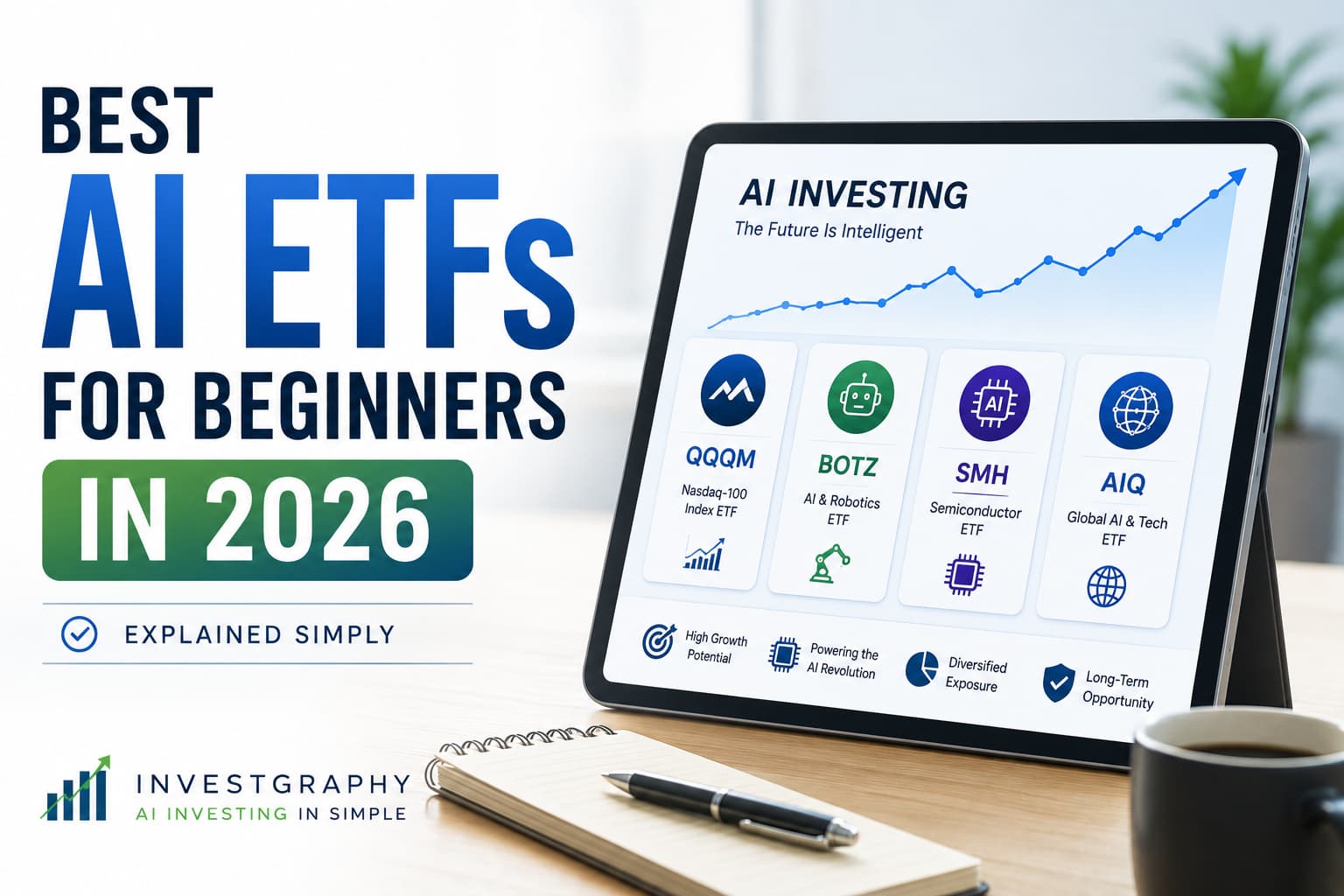
Best AI ETFs for Beginners in 2026 Explained Simply

Last Updated: May 2026 · 6 min read · AI ETFs
Key Takeaways
- An AI ETF lets you invest in dozens of AI companies at once — without picking individual stocks
- QQQM has the lowest expense ratio of any fund on this list at 0.15% — and $72 billion in assets under management
- AIQ and BOTZ both charge 0.68% but cover meaningfully different parts of the AI market
- CHAT is the only actively managed fund here — higher cost at 0.75% but returned 82% over the past year
- Expense ratio matters more than most beginners realise — even a 0.5% difference compounds significantly over a decade
An AI ETF is a fund that holds a basket of AI-related stocks, letting you invest in the entire sector without selecting individual companies. The best AI ETFs for beginners in 2026 are QQQM for low cost and broad tech exposure, AIQ for diversified global AI coverage, BOTZ for robotics and infrastructure tilt, ARTY for infrastructure-focused holdings, and CHAT for actively managed generative AI exposure. Each covers the AI theme differently — the right one depends on what you are trying to own.
| ETF | Expense Ratio | AUM | Best For |
| QQQM | 0.15% | $72.3B | Lowest cost, broad tech |
| AIQ | 0.68% | $7.86B | Global AI diversification |
| BOTZ | 0.68% | $3.56B | Robotics and hardware |
| ARTY | 0.47% | $932.9M | AI infrastructure tilt |
| CHAT | 0.75% | $1.06B | Active generative AI |
What Is an AI ETF and Why Do Beginners Use Them
An ETF — exchange-traded fund — is a basket of stocks that trades on a stock exchange like a single share. When you buy one share of an AI ETF, you are effectively buying a small piece of every company inside that fund.
For a beginner, this matters for one reason: you do not have to pick winners. Instead of betting that NVIDIA specifically outperforms AMD, or that one cloud provider beats another, you own a spread of companies across the entire AI sector. If the sector grows, your investment tends to grow with it.
The AI market is projected to reach $4.8 trillion by 2033, up from $189 billion in 2023. An ETF is the most practical way for a beginner to get exposure to that growth without the risk of picking the wrong individual company.
The 5 Best AI ETFs for Beginners in 2026
QQQM — Invesco NASDAQ 100 ETF
Best for: Beginners who want broad tech exposure at the lowest possible cost
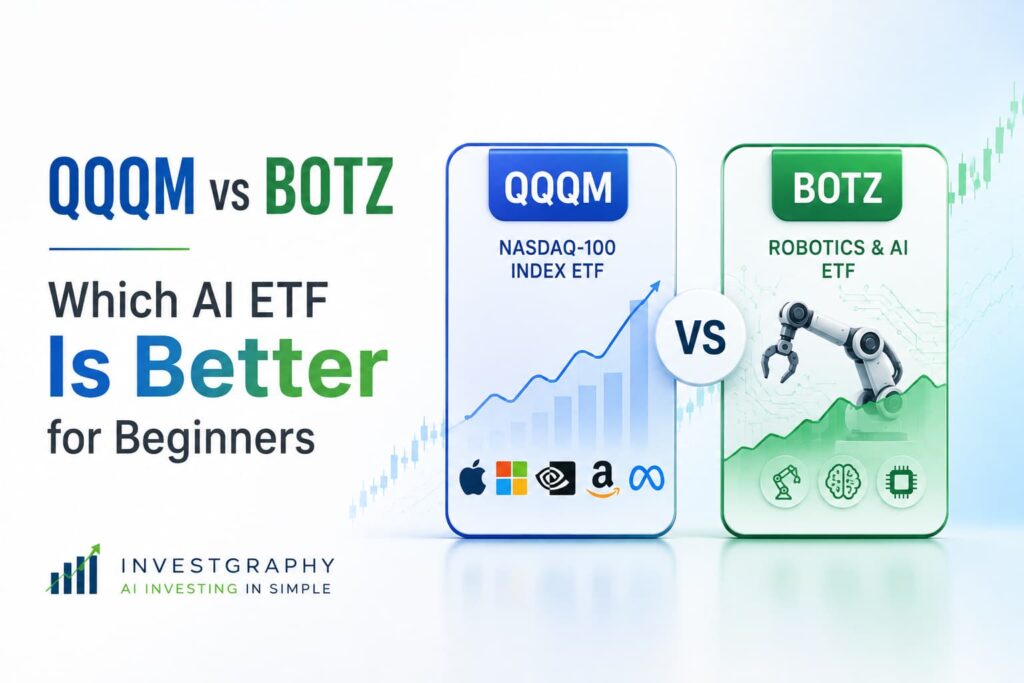
Expense ratio: 0.15% Assets under management: $72.3 billion Top holdings: Apple, Microsoft, NVIDIA, Alphabet, Meta, Amazon
QQQM tracks the NASDAQ 100 — the 100 largest non-financial companies listed on the NASDAQ exchange. In practice, this means heavy exposure to every major AI player: NVIDIA, Microsoft, Alphabet, Meta, and Amazon are all top holdings.
It is not a pure AI fund. It is a broad technology fund that happens to be dominated by the same companies driving the AI buildout. The 0.15% expense ratio is the lowest on this list by a significant margin — meaning more of your money stays invested rather than going to fund fees.
QQQM is the smaller-investor version of the famous QQQ fund — identical portfolio, lower minimum cost per share, slightly lower fee. For a beginner starting with a small amount, QQQM is the more accessible entry point.
AIQ — Global X Artificial Intelligence & Technology ETF
Best for: Beginners who want dedicated AI exposure across global markets
Expense ratio: 0.68% Assets under management: $7.86 billion Top holdings: Taiwan Semiconductor (TSMC), Apple, Cisco, Samsung, Alphabet
AIQ tracks the Indxx Artificial Intelligence & Big Data Index — a purpose-built AI index covering companies that use AI to analyse big data, either for their own operations or as a service to other companies.
With 87 holdings across developed markets globally, AIQ gives broader geographic diversification than a US-only fund. TSMC and Samsung as top holdings means significant exposure to the semiconductor manufacturing layer — the companies physically producing the chips that AI runs on.
The 0.68% expense ratio is on the higher end for a passively managed index fund. Over a decade, that cost compounds meaningfully compared to QQQM. But for a beginner who specifically wants AI-focused exposure rather than broad technology, AIQ delivers it more precisely than QQQM.
BOTZ — Global X Robotics & Artificial Intelligence ETF
Best for: Beginners who want exposure to AI hardware and robotics specifically
Expense ratio: 0.68% Assets under management: $3.56 billion Top holdings: NVIDIA, ABB Ltd, FANUC, Keyence, Intuitive Surgical
BOTZ focuses on companies directly involved in robotics and AI — industrial automation, autonomous systems, and the hardware that powers them. Its portfolio of roughly 50 companies has a heavier tilt toward industrial and healthcare firms compared to a pure technology fund, and a notable allocation to Japanese robotics companies.
Over the past six months BOTZ returned 14.86% — slightly ahead of AIQ’s 11.1% over the same period. The concentration in physical AI infrastructure and robotics makes it a different bet than software-heavy AI funds.
The tradeoff is concentration risk — with only 50 holdings, the performance of a small number of companies has an outsized impact on the fund. Not ideal as a first-ever investment, but a reasonable complement to a broader fund like QQQM.
ARTY — iShares Future AI & Tech ETF
Best for: Beginners who want AI infrastructure exposure at a reasonable cost
Expense ratio: 0.47% Assets under management: $932.9 million Top holdings: Vertiv Holdings, Broadcom, Arista Networks, NVIDIA
ARTY is notable for what it holds more than what it tracks. Vertiv and Arista Networks — two of the clearest picks-and-shovels infrastructure plays in AI — are top holdings. This gives ARTY a meaningful tilt toward the physical AI infrastructure layer: power systems, cooling, and high-performance networking.
At 0.47% the expense ratio sits between the low-cost QQQM and the pricier AIQ and BOTZ. With roughly 50 holdings, it is more concentrated than AIQ but more diversified than BOTZ.
For a beginner who read about AI infrastructure investing and wants a fund specifically weighted toward that theme, ARTY is the most direct ETF option on this list.
CHAT — Roundhill Generative AI & Technology ETF
Best for: Beginners comfortable with higher fees in exchange for active management
Expense ratio: 0.75% Assets under management: $1.06 billion Management style: Actively managed — does not track an index
CHAT is the only actively managed fund on this list. Rather than passively tracking an index, the fund manager selects stocks using a proprietary scoring methodology that evaluates companies based on their AI revenue, R&D investment, and exposure to generative AI specifically.
It returned 82% over the past year — the strongest one-year performance of any fund on this list. It also applies a 50% revenue-purity screen, meaning holdings must derive a meaningful share of revenue from generative AI businesses.
The risk with actively managed funds is that past performance does not guarantee future results. The 0.75% expense ratio is the highest here. For a beginner building their first position, CHAT is better as a secondary fund after establishing a low-cost core holding like QQQM first.
How to Compare AI ETFs — 3 Numbers That Matter
Before buying any ETF, look at three things:
Expense ratio — this is the annual fee deducted from your investment. A 0.68% expense ratio on a $10,000 investment costs $68 per year. That sounds small. Over 20 years with compounding, the difference between 0.15% and 0.68% can amount to thousands of dollars. Always know what you are paying.
Assets under management (AUM) — larger funds are generally more liquid and more stable. A fund with $72 billion in AUM like QQQM is not going to close down. A fund with $110 million in AUM carries more risk of being wound up if the theme falls out of favour.
Top holdings — the fund name tells you very little. The actual top 10 holdings tell you what you are really buying. Two AI ETFs can hold completely different companies. Always read the holdings list before investing.
FAQ
What is the best AI ETF for beginners in 2026?
For most beginners, QQQM is the most practical starting point — it has the lowest expense ratio at 0.15%, $72 billion in assets, and includes every major AI company as top holdings. It is not a pure AI fund but it gives broad, low-cost exposure to the companies driving the AI buildout. For dedicated AI exposure, AIQ or ARTY are worth researching. This is not financial advice — always research each fund and consult a financial advisor before investing.
What is an expense ratio and why does it matter?
An expense ratio is the annual fee an ETF charges to cover its operating costs, expressed as a percentage of your investment. A 0.15% expense ratio means you pay $15 per year on a $10,000 investment. A 0.75% expense ratio costs $75 on the same amount. The difference compounds over time — over a decade, a higher expense ratio can meaningfully reduce your total returns even if the underlying performance is similar.
Is QQQM the same as QQQ?
Yes — QQQM and QQQ track the same index and hold the same portfolio of NASDAQ 100 companies. The difference is that QQQM has a slightly lower expense ratio at 0.15% versus QQQ’s 0.20%, and a lower share price that makes it more accessible for investors starting with smaller amounts. For a long-term buy-and-hold investor, QQQM is generally considered the more cost-efficient option.
Should a beginner buy one AI ETF or multiple?
For most beginners, starting with one broad low-cost fund is simpler and more practical than buying multiple thematic ETFs. Adding more funds only makes sense once you understand what each one holds and how they differ — otherwise you risk owning overlapping positions without realising it. A common overlap is that QQQM, AIQ, and BOTZ all hold NVIDIA — buying all three does not triple your NVIDIA exposure benefit, it just increases your fees.
Conclusion
AI ETFs remove the hardest part of investing in a fast-moving sector — picking which individual company wins. For a beginner, that matters more than finding the single best-performing fund.
QQQM keeps costs low and covers the entire AI landscape through the NASDAQ 100. AIQ gives you dedicated global AI exposure. ARTY tilts toward the infrastructure layer powering everything else. BOTZ focuses on robotics and hardware. CHAT offers active management for those willing to pay for it.
None of these are recommendations. They are the starting points for your own research.
Want a plain English breakdown of what is moving in AI investing every week? Subscribe to the Investgraphy brief — free, five minutes, no hype.