
Now Reading: Why AI Runs on Electricity The Energy Stocks Nobody Talks About
-
01
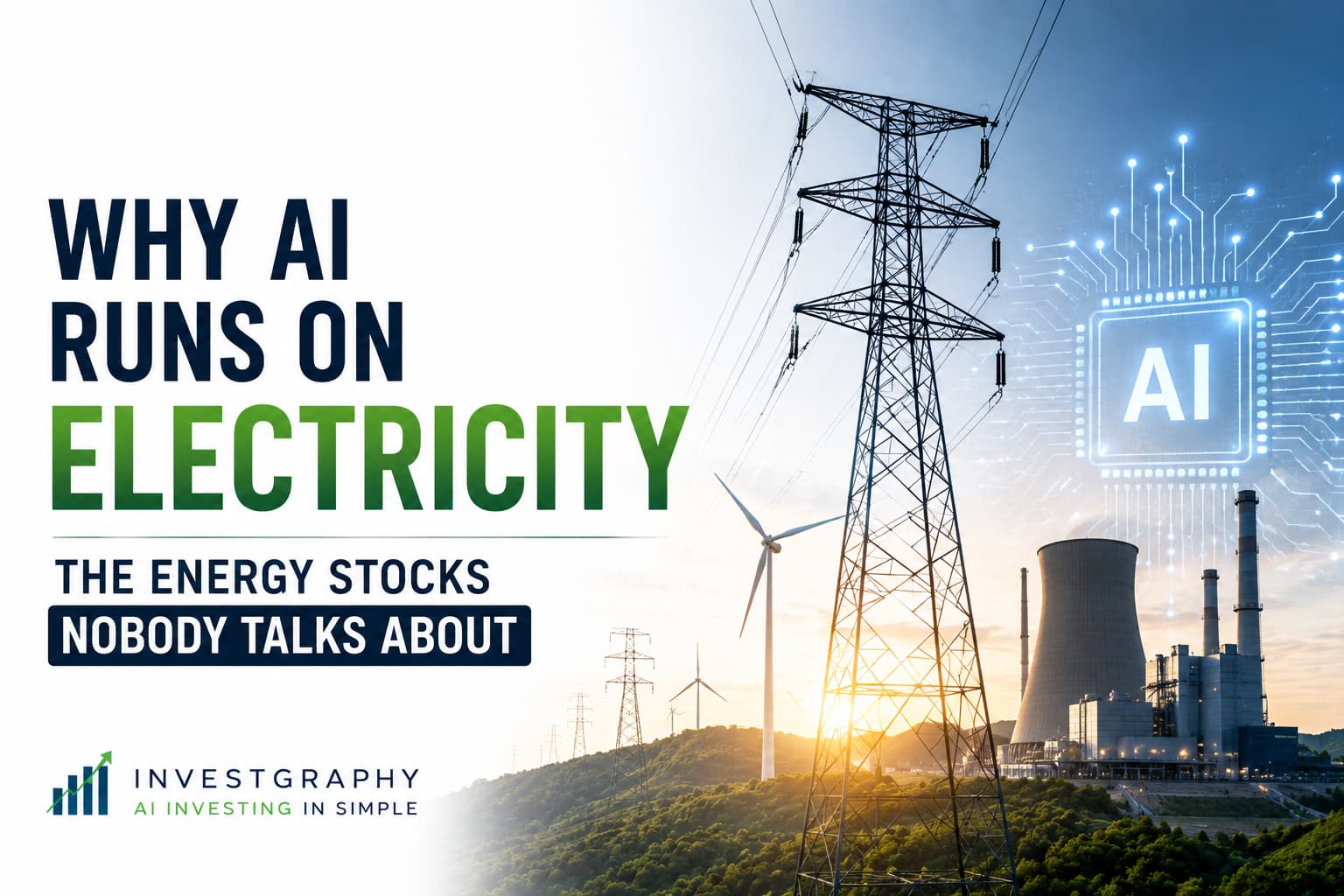
Why AI Runs on Electricity The Energy Stocks Nobody Talks About

Key Takeaways
- Data center electricity demand surged 17% in 2025 — the fastest growth rate in over a decade — according to the International Energy Agency
- A single large data center now consumes between 100 and 300 megawatts of power — roughly equivalent to a small city
- Data centers are projected to consume 11% of all US electricity by 2030, up from 6% today
- Energy companies supplying AI data centers are signing long-term power contracts with the largest tech companies in the world
Every AI model that runs requires electricity — enormous amounts of it. Data center electricity demand surged 17% in 2025 alone, growing at five times the rate of global electricity demand overall. By 2030, data centers are projected to consume 11% of all US electricity. The energy companies supplying that power — nuclear operators, gas turbine manufacturers, grid equipment suppliers — are signing multi-year contracts directly with Amazon, Microsoft, and Google. Most beginner investors have never heard of them.
The Problem Nobody Talks About
When most people think about AI investing, they think about chips or software. Almost nobody thinks about electricity.
But here is the physical reality: a single large data center consumes between 100 and 300 megawatts of power. That is roughly the electricity demand of a small city — running 24 hours a day, 7 days a week, without interruption. And hyperscalers are not building one data center. They are building hundreds.
The International Energy Agency reported that electricity demand from data centers surged 17% in 2025 — far outpacing global electricity demand growth of 3%. AI-focused data centers grew even faster. The IEA projects data center electricity consumption will double by 2030 — and power use from AI-specific facilities will triple.
The chips get the headlines. The electricity bills are where the bottleneck actually is.
How Big the Numbers Actually Are
Today, data centers represent approximately 6% of total US electricity consumption. By 2030, that share is projected to nearly double to 11% — a shift significant enough to reshape how utility companies plan their grids for years ahead.
In absolute terms, US data center power consumption is on track to hit 750 terawatt-hours by 2030. US data center capacity is expected to grow 197% between 2025 and 2030, reaching 95 gigawatts. To put that in context — 95 gigawatts is more than the entire electricity generating capacity of many mid-sized countries.
Large technology companies understood this problem early. Google, Meta, and Amazon were already collectively the largest corporate buyers of renewable energy in the world as of 2024, accounting for 43% of all clean energy power purchase agreements signed globally that year. That was not environmental policy. That was a supply problem they had to solve.
Who Actually Profits From AI’s Power Demand
Three categories of energy companies are directly benefiting from this shift — and most retail investors have not yet connected them to the AI story.
Nuclear operators — AI hyperscalers need power that runs 24 hours a day without interruption. Solar and wind are intermittent. Nuclear is not. Microsoft signed a 20-year agreement with Constellation Energy to restart the Three Mile Island nuclear plant in Pennsylvania — a $1.6 billion investment specifically to power Microsoft’s data centers. Constellation operates the largest fleet of nuclear plants in the United States and has signed long-term power agreements with multiple major tech companies.
Gas turbine and grid equipment manufacturers — GE Vernova reported $2.4 billion in data center-related orders in just the first quarter of 2026 — already exceeding its entire 2025 total. The company supplies the gas turbines and grid infrastructure that connect data centers to power networks. Eaton Corp supplies electrical systems that manage power delivery inside data center facilities.
Power utilities with data center contracts — Vistra and Constellation Energy have both secured long-term power supply agreements with Amazon and Meta. These are not speculative bets on future demand. They are signed contracts providing forward revenue visibility that most technology companies do not have.
The Nuclear Renaissance Nobody Expected
For years, nuclear energy was politically unpopular and economically difficult. AI changed that conversation almost overnight.
The pipeline of agreements between data center operators and small modular reactor nuclear projects grew from 25 gigawatts at the end of 2024 to 45 gigawatts as of early 2026, according to the IEA. Hyperscalers are not waiting for governments to solve the energy problem. They are contracting power directly from nuclear operators decades into the future.
The reason is simple: AI data centers need always-on, carbon-free power. Nuclear is the only energy source that reliably delivers both. Tech companies that have made public climate commitments cannot use fossil fuels at scale. And solar and wind cannot run a data center through the night.
This is why nuclear energy went from a politically dead industry to one of the most actively courted sectors in infrastructure finance — in under two years.
What Beginners Should Understand Before Investing
Energy stocks are not the same as technology stocks. They tend to move more slowly, pay dividends more often, and carry different risks.
The investment case here is not about explosive growth. It is about structural demand that is locked in by multi-year contracts with the largest companies in the world. A power utility that has a 20-year agreement to supply Microsoft is not guessing about its revenue for the next two decades.
The risks are real too. Grid connection delays are a genuine bottleneck — regulatory and permitting backlogs are slowing data center deployment in multiple US regions. If data center construction slows, energy demand growth slows with it. Nuclear projects also carry long development timelines and construction risk.
For beginner investors, ETFs that include utility companies, nuclear operators, and energy infrastructure providers offer diversified exposure without requiring individual stock selection. Research the space before committing capital, and consult a financial advisor before making any investment decisions.
FAQ
Why do AI data centers use so much electricity?
AI models require massive parallel computing performed by thousands of GPUs running simultaneously. The IEA reports that IT equipment — primarily servers and GPU accelerators — accounts for around 60% of electricity demand in modern data centers. Those machines run continuously, generating heat that requires additional power for cooling systems. A single large data center can consume as much electricity as a small city.
Which energy companies benefit most from AI data center growth?
Nuclear operators like Constellation Energy and power equipment manufacturers like GE Vernova and Eaton Corp are frequently cited by analysts as direct beneficiaries of AI data center power demand. These companies are signing long-term contracts with hyperscalers including Microsoft, Amazon, and Meta. This is not an exhaustive list — research each company independently before making any investment decisions.
Why are tech companies investing in nuclear energy?
AI data centers need power that runs 24 hours a day without interruption — something solar and wind cannot reliably provide. Nuclear energy delivers always-on, carbon-free baseload power, making it the preferred solution for tech companies that need to meet both operational and sustainability requirements. Microsoft restarted Three Mile Island specifically to power its data centers. The pipeline of nuclear agreements with data center operators more than doubled between 2024 and early 2026.
Is it too late to invest in AI energy stocks?
Analysts at Morgan Stanley, IEA, and Brookings all suggest that AI-driven electricity demand growth is a multi-year structural trend running through at least 2030. Whether any specific company or ETF is a good investment depends on your individual financial situation, risk tolerance, and the valuations at the time you research them. This is not financial advice — always conduct your own research and consult a qualified financial advisor.
Everyone focused on the chip race. Very few people looked at what the chips run on.
Data center electricity demand surged 17% in 2025. It is projected to double by 2030. The energy companies supplying that power are not speculating on AI adoption — they are collecting on 20-year contracts already signed by Microsoft, Amazon, and Google.
The AI story is not just a semiconductor story. It is an electricity story. And most beginner investors are only paying attention to half of it.
Want one clear insight like this every week? Subscribe to the Investgraphy brief — five minutes, plain English, no hype.
This article is for educational and informational purposes only and does not constitute financial advice. All figures cited are sourced from publicly available reports including the International Energy Agency, Morgan Stanley, Brookings Institution, and company earnings disclosures. Investing involves risk including possible loss of principal. Always conduct your own research and consult a qualified financial advisor before making investment decisions.
About the Author
Investgraphy Team · Independent AI investing education for self-directed beginners. No hype, no jargon, no financial advice.