
Now Reading: S&P 500 vs AI ETFs Which Is Better for Beginners
-
01
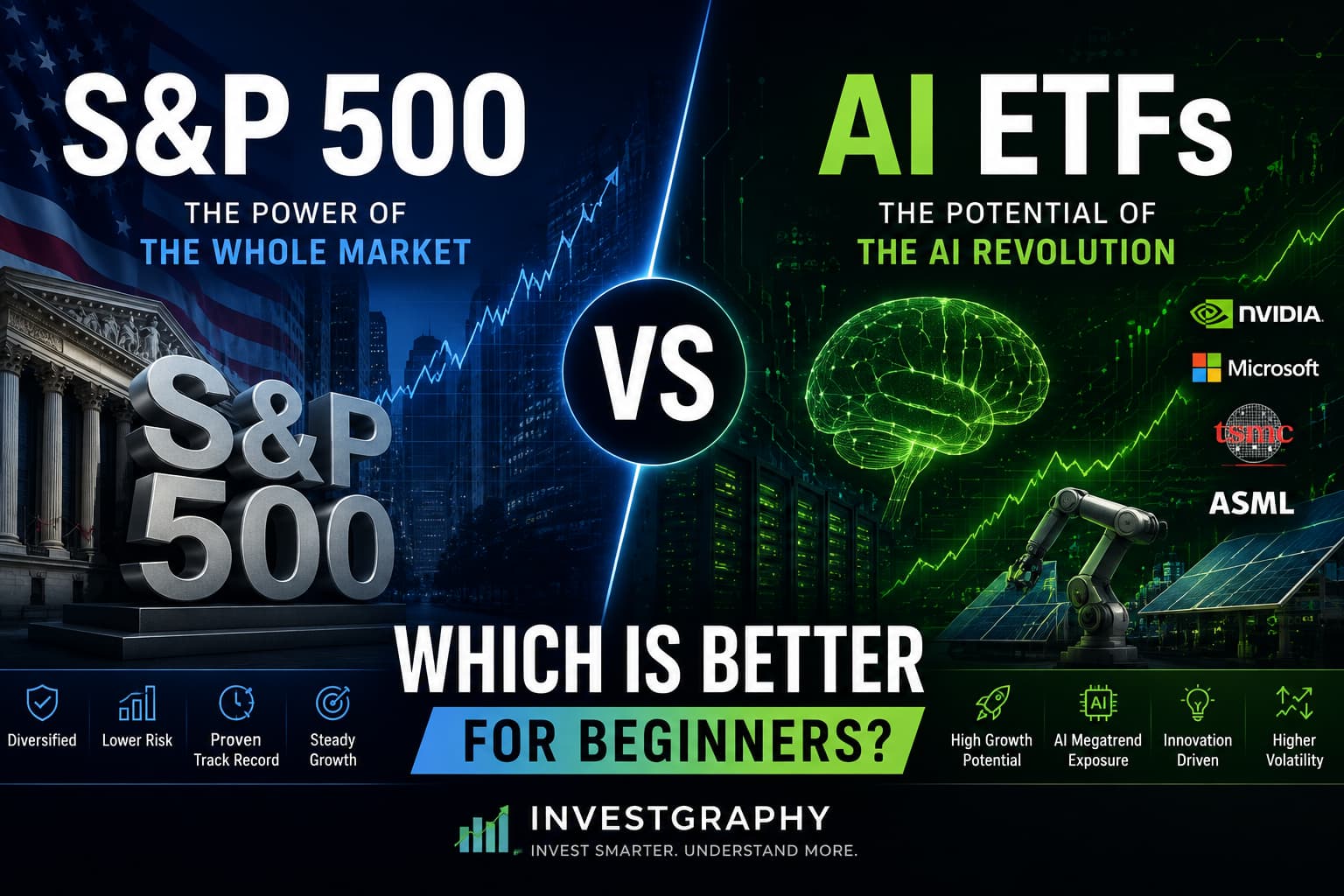
S&P 500 vs AI ETFs Which Is Better for Beginners

Last Updated: May 2026 · 6 min read · AI ETFs
Key Takeaways
- QQQM, an AI-heavy NASDAQ 100 fund, returned 33.41% over the past year versus 22.23% for VOO, which tracks the S&P 500
- Over five years, QQQM’s annualized return of 16.19% beats VOO’s 13.10%, but QQQM has also seen sharper drawdowns, including a 32.52% decline in 2022 versus VOO’s milder 18.17% fall
- VOO holds 505 companies across every sector; QQQM concentrates in 100 mostly technology companies, with roughly 37% tech weighting versus VOO’s more balanced spread
- Both funds already overlap significantly: VOO’s top three holdings are NVIDIA, Apple, and Microsoft, the same companies that dominate QQQM
- The right choice depends on how much volatility you can tolerate in exchange for the AI sector’s faster historical growth, not which fund is objectively “better”
QQQM, a fund heavily weighted toward AI and technology companies, has outperformed VOO, the most popular S&P 500 ETF, in both one-year and five-year returns: 33.41% versus 22.23% over the past year, and 16.19% versus 13.10% annualized over five years. The tradeoff is volatility. QQQM fell 32.52% in 2022 while VOO fell only 18.17% the same year. Neither fund is universally better. VOO offers broader diversification and lower fees, while QQQM offers concentrated exposure to the companies driving AI growth, with correspondingly larger swings in both directions.
What Each Fund Actually Tracks
VOO tracks the S&P 500: 505 of the largest publicly traded companies in the United States across every major sector. Its largest sector weighting is technology at roughly 37%, followed by financial services at 13% and consumer cyclical at 11%. Its top three holdings are NVIDIA, Apple, and Microsoft, but because the fund spans healthcare, utilities, energy, industrials, and financials as well, no single sector dominates the way it does in a NASDAQ-focused fund.
QQQM tracks the NASDAQ 100: the 100 largest non-financial companies listed on the NASDAQ exchange. By design, this concentrates the fund heavily in technology, with the average holding trading at a notably higher valuation than the S&P 500’s average. QQQM excludes financials, energy, and many other sectors entirely, focusing almost exclusively on technology, communication services, and consumer discretionary companies.
This is the most important structural difference to understand: VOO is a bet on the entire US economy. QQQM is a much more concentrated bet on technology and AI-adjacent growth specifically.
The Performance Numbers Side by Side
| Metric | QQQM | VOO |
|---|---|---|
| Tracks | NASDAQ 100 | S&P 500 |
| Number of holdings | 102 | 505 |
| Expense ratio | 0.15% | 0.03% |
| 1-year return | 33.41% | 22.23% |
| 5-year annualized return | 16.19% | 13.10% |
| 2022 return (down year) | -32.52% | -18.17% |
| 2023 return (up year) | +55.01% | +26.32% |
| Dividend yield | 0.45% | 1.05% |
| Tech sector weighting | ~60%+ | ~37% |
The pattern across these numbers is consistent. QQQM wins on growth in good years by a wide margin. VOO loses less in bad years by an equally wide margin. Over a full five-year cycle that included both a strong bull market and a sharp 2022 downturn, QQQM still came out ahead on annualized return, but an investor holding it experienced a much rougher ride to get there.
QQQ and QQQM have actually beaten the S&P 500 in seven of the last ten years through March 2026. That track record is real. It is also not a guarantee that the next ten years follow the same pattern, particularly given how concentrated the recent gains have been in a small number of mega-cap AI companies.
Why the Volatility Difference Matters More Than the Headline Returns
A 33.41% return looks obviously better than 22.23% on paper. The number that matters just as much is how much an investor has to tolerate losing during the bad years to capture that extra growth.
In 2022, an investor holding $10,000 in QQQM watched their account fall to roughly $6,748. An investor holding the same amount in VOO watched their account fall to roughly $8,183. Both investors who held through the recovery eventually came out ahead, but the QQQM investor experienced a materially larger paper loss along the way, and a larger drawdown is more likely to trigger panic selling at exactly the wrong moment.
This is not a hypothetical concern. A consistent finding in retail investor behavior research is that sharper drawdowns lead to higher rates of investors selling at a loss near the bottom, locking in losses that a buy-and-hold investor in a less volatile fund would have avoided. The extra return QQQM has delivered historically only benefits investors who can actually stay invested through declines like 2022, emotionally as much as financially.
The Overlap Most Beginners Don’t Realize
Here is something that surprises a lot of beginners researching this comparison: VOO and QQQM are not as different as their names suggest.
VOO’s top three holdings, NVIDIA, Apple, and Microsoft, are also QQQM’s largest positions. The correlation between the two funds is approximately 0.92 to 0.94, meaning they move in a very similar direction most of the time. Holding both funds in significant size does not provide as much diversification benefit as it might appear, because you would effectively be doubling up on exposure to the same handful of mega-cap technology companies that dominate both indexes.
This matters for portfolio construction. An investor who already owns VOO and adds QQQM on top is not meaningfully diversifying away from AI and technology risk. They are concentrating further into it, just through two different fund wrappers.
When Each Fund Makes More Sense
VOO makes more sense if you want the broadest possible exposure to the US economy with the lowest fees available; its 0.03% expense ratio is among the cheapest of any ETF in existence. It also makes sense if you have a lower tolerance for volatility, a shorter time horizon, or you specifically want exposure to sectors the NASDAQ 100 excludes entirely, like financials, energy, and healthcare.
QQQM makes more sense if you have a long time horizon, ideally 10 years or more, and specifically want concentrated exposure to the technology and AI theme, understanding that this comes with materially larger swings in both directions. It also makes sense as a complement to a more diversified core holding, sized appropriately so a sharp drawdown does not threaten your broader financial plan.
A reasonable middle path that many beginners overlook entirely is simply holding VOO alone. Because NVIDIA, Microsoft, and Apple are already top holdings inside VOO, a beginner gets meaningful AI exposure through a single, cheaper, more diversified fund, without needing to add a second, more concentrated position on top.
FAQ
Is QQQM a better investment than VOO?
QQQM has historically delivered higher returns than VOO: 33.41% over the past year and 16.19% annualized over five years, compared to 22.23% and 13.10% for VOO. However, QQQM has also experienced sharper losses during downturns, falling 32.52% in 2022 compared to VOO’s 18.17% decline. Whether QQQM is “better” depends entirely on your time horizon and tolerance for volatility, not simply which fund has produced higher historical returns. This is not financial advice; always research before investing.
Do I need both an S&P 500 ETF and an AI ETF?
Not necessarily. VOO and QQQM have a correlation of approximately 0.92 to 0.94, and VOO already holds NVIDIA, Apple, and Microsoft as top positions. Holding both funds in significant amounts does not provide as much diversification as many beginners assume, since you would be doubling exposure to the same dominant technology companies. Some beginners choose to hold VOO alone for broad exposure with built-in AI exposure, while others deliberately add QQQM for additional concentrated growth potential, accepting the additional volatility that comes with it.
Why did QQQM fall more than VOO in 2022?
QQQM tracks the NASDAQ 100, which is heavily concentrated in technology and growth-oriented companies. These companies are typically more sensitive to rising interest rates, since their valuations rely more heavily on future earnings growth that gets discounted more severely when rates rise. VOO’s broader exposure across financials, energy, healthcare, and other sectors that performed comparatively better in 2022 helped cushion its overall decline relative to QQQM’s tech-heavy concentration.
What is the safest way for a beginner to get AI exposure without high volatility?
A broad S&P 500 ETF like VOO already provides meaningful AI exposure through its top holdings, NVIDIA, Apple, and Microsoft, while spreading risk across 505 companies and multiple sectors. This generally results in lower volatility than a concentrated technology fund like QQQM, at the cost of lower potential upside during strong AI-driven rallies. For beginners specifically concerned about volatility, starting with a broad fund like VOO and adding more concentrated exposure later, once comfortable with market swings, is a commonly recommended approach.
There is no objectively correct answer to S&P 500 versus AI-heavy ETFs, only a tradeoff that depends on your own time horizon and tolerance for volatility. QQQM has delivered stronger returns over the past one and five years. VOO has delivered a smoother ride, lower fees, and broader diversification, while still providing real exposure to the same AI companies driving QQQM’s growth.
For most beginners, understanding that VOO already contains meaningful AI exposure, without the concentrated volatility of a NASDAQ-focused fund, is the single most useful insight in this comparison. The decision is not AI exposure versus no AI exposure. It is how concentrated you want that exposure to be.
Want clear, honest ETF comparisons every week? Subscribe to the Investgraphy brief: free, five minutes, no hype.
This article is for educational and informational purposes only and does not constitute financial advice. All performance figures are sourced from PortfoliosLab, StockAnalysis, Mezzi, Invesco, and Motley Fool as of May 2026. Past performance does not guarantee future results. ETF data including returns, expense ratios, and holdings change frequently; always verify current figures before making investment decisions. Investing involves risk including possible loss of principal. Always conduct your own research and consult a qualified financial advisor.
About the Author
Investgraphy Team: Independent AI investing education for self-directed beginners. No hype, no jargon, no financial advice.