
Now Reading: What Is a GPU And Why Does Every AI System Depend on One?
-
01
What Is a GPU And Why Does Every AI System Depend on One?

Last Updated: May 2026 · 6 min read · AI Technology
Key Takeaways
- A GPU — graphics processing unit — is a chip originally designed for video games that turned out to be the perfect hardware for running AI
- Where a standard computer chip handles one task at a time, a GPU handles thousands of calculations simultaneously — exactly what AI training and inference require
- NVIDIA’s current Blackwell GPU delivers roughly 5x the AI performance of its previous generation H100 chip, and delivers AI inference at approximately $0.02 per million tokens versus $0.09 for the H100
- NVIDIA CEO Jensen Huang described Blackwell demand as “extraordinary — every customer wants more than we can supply” — and the company pre-allocated nearly all B200 production through Q2 2026
- Every major AI model in the world — from ChatGPT to Google Gemini to Meta’s Llama — runs on NVIDIA GPUs
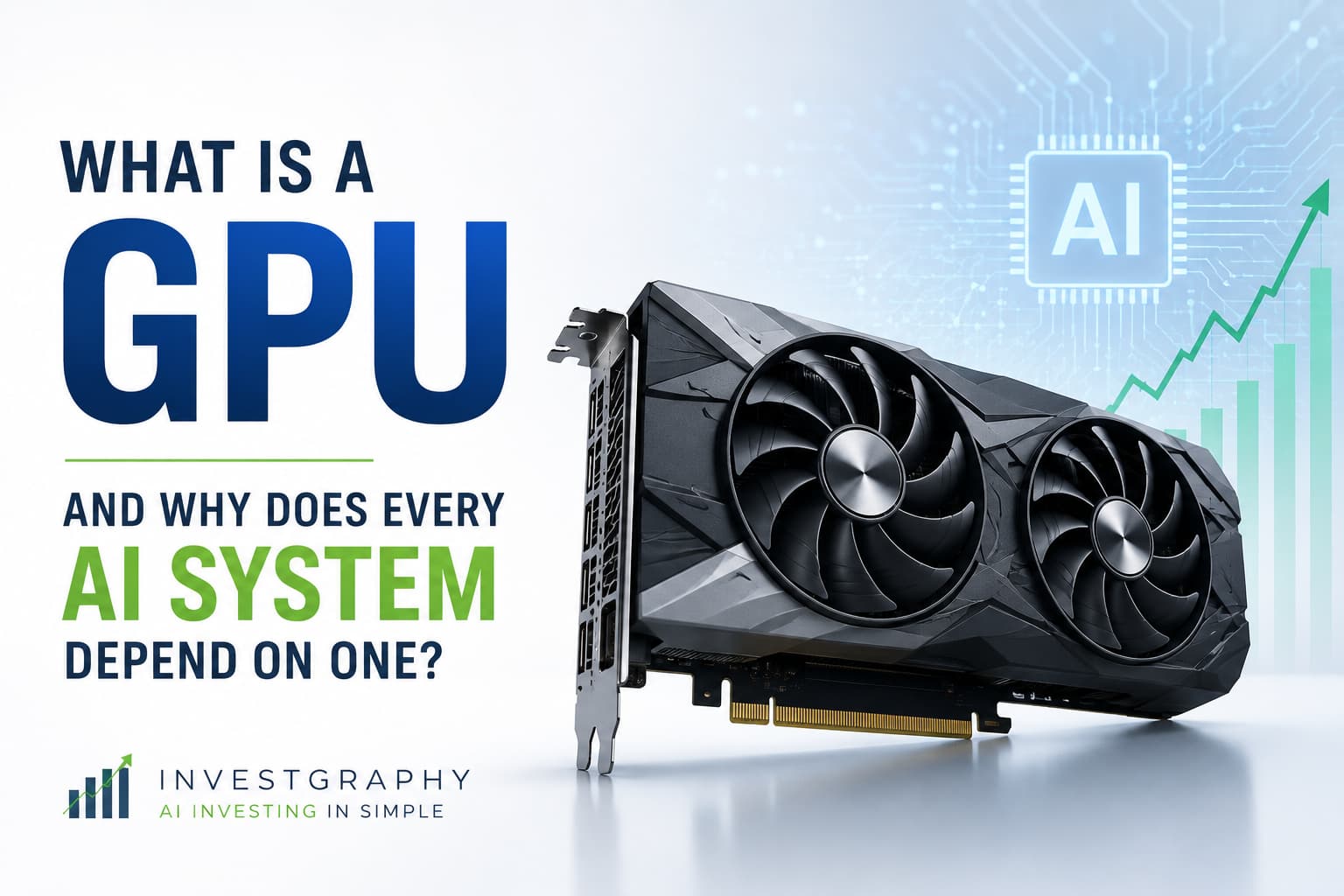
A GPU, or graphics processing unit, is a type of computer chip designed to perform thousands of calculations simultaneously rather than one at a time. This parallel processing ability — originally built for rendering video game graphics — turned out to be exactly what AI systems need to train and run. Without GPUs, the AI tools you use every day would take hours to respond instead of seconds. NVIDIA designs the GPUs that power virtually every major AI system in the world, making it the most important hardware company in the current AI buildout.
The Difference Between a CPU and a GPU
To understand what a GPU is, it helps to first understand what it is not.
A CPU — central processing unit — is the main processor inside every computer, phone, and server. It handles tasks sequentially, one after another, with great speed and flexibility. Think of a CPU as a highly skilled individual who can handle complex, varied tasks — but only one at a time.
A GPU works completely differently. Instead of a few powerful processing cores handling one task each, a GPU contains thousands of smaller, simpler cores all working simultaneously. Think of it as an enormous team of workers each doing one small, specific task at the exact same time.
For most computing tasks — browsing the web, sending an email, running a spreadsheet — the CPU’s approach works fine. But for tasks that require processing enormous amounts of data in parallel — like rendering thousands of pixels in a video game, or training an AI model on billions of data points — the GPU’s parallel approach is not just faster. It is the only practical approach at all.
Why AI Cannot Function Without GPUs
Training an AI model means showing it billions of examples — text, images, or other data — and adjusting millions of internal parameters until the model learns to make accurate predictions. Each adjustment requires performing millions of mathematical calculations. And that process gets repeated, again and again, until the model converges on accurate behavior.
For a large language model — the type of AI behind ChatGPT or Google Gemini — this training process can require running hundreds of billions of calculations simultaneously, for weeks, across thousands of chips working in parallel.
A CPU simply cannot keep up. Even the fastest CPUs in existence can handle perhaps a few hundred threads of parallel computation at once. A single NVIDIA H100 GPU — one generation behind the current Blackwell architecture — handles 16,896 parallel processing cores simultaneously. Scale that to a data center running thousands of H100 or Blackwell GPUs simultaneously, and you begin to understand the scale of compute that modern AI requires.
AI inference — the process that happens every time you send a message to an AI tool and receive a response — also depends on GPUs. Each response requires the model to perform billions of calculations in milliseconds. Without GPU acceleration, responses that currently take one second would take minutes or longer, making real-time AI interaction effectively impossible.
NVIDIA’s GPU Generations — From H100 to Blackwell
NVIDIA has released several major GPU generations specifically targeting AI workloads. Understanding them helps investors make sense of the company’s product roadmap and revenue trajectory.
Hopper (H100 and H200)
Released from 2022 onward, the H100 became the dominant AI training chip globally. It contains 80 billion transistors and was adopted by every major AI company — OpenAI, Google, Meta, Microsoft, and Anthropic all built significant infrastructure around H100 clusters. The H100 remained in heavy enterprise use through 2025 and is still widely deployed.
Blackwell (B200 and GB200)
NVIDIA’s current architecture, shipping through 2025 and 2026. Blackwell delivers roughly 5x the AI inference performance of the H100 per GPU, using a dual-die design with 208 billion transistors and 192 gigabytes of the fastest available memory — HBM3e. NVIDIA pre-allocated nearly all B200 production through Q2 2026, with hyperscalers including Microsoft, Google, Amazon, and Meta receiving priority. Jensen Huang described the demand directly: “The demand for Blackwell is extraordinary. Every customer wants more than we can supply.”
The performance improvement is measurable in concrete terms. The H100 delivers AI inference at approximately $0.09 per million tokens. The current Blackwell B200 delivers the same inference at approximately $0.02 per million tokens — a cost reduction that makes large-scale AI deployment meaningfully more economical for every company running AI at scale.
Vera Rubin — Next Generation
Already in full production as of mid-2026. The Vera Rubin architecture pairs two Rubin GPUs with a custom ARM processor on a single chip, connected at 1.8 terabytes per second. Hyperscaler cloud access begins in the second half of 2026, with broader enterprise availability expected in mid-2027. NVIDIA has consistently released a major new architecture every one to two years, maintaining a product cadence that keeps competitors scrambling to catch up to the previous generation while NVIDIA ships the next one.
Why GPU Scarcity Is an Investment Story
The demand for NVIDIA’s GPUs consistently exceeds supply — and that supply constraint has direct investment implications.
When a hyperscaler like Amazon, Microsoft, or Google commits to spending tens of billions on AI infrastructure, a significant portion of that spending goes to securing GPU allocations from NVIDIA. Because supply is constrained and demand is compounding — every new AI application launched by every company worldwide requires more GPU compute — NVIDIA’s pricing power has remained exceptional.
This supply-demand dynamic is also why NVIDIA reported $81.6 billion in total revenue for the quarter ending April 2026, with data center revenue of $75.2 billion — up 92% from the same quarter a year earlier. That growth rate does not happen in a mature, commoditized market. It happens when you make something essential that everyone wants and nobody else can fully replicate.
AMD’s MI300X chip has gained real traction — it matches the B200 on memory capacity with 192 gigabytes of HBM3 and has won deployment at Microsoft Azure and Meta. But the broader software ecosystem that makes GPUs productive for AI development — NVIDIA’s CUDA platform — remains the dominant environment for AI research and production deployment. Switching away from CUDA means rewriting significant amounts of code, which is why NVIDIA’s market position is so difficult to displace even when a competitor ships competitive hardware.
What This Means for a Beginner Investor
You do not need to understand GPU architecture in technical detail to understand its investment significance. The core insight is simpler than that.
Every AI model trained anywhere in the world requires GPUs. Every AI inference request processed anywhere in the world requires GPUs. As the number of AI applications grows — in healthcare, logistics, finance, entertainment, manufacturing — the demand for GPU compute grows with it. And as AI models become larger and more capable, each one requires more compute than the last.
NVIDIA sits at the center of that demand. It is not the only company involved — AMD provides a genuine secondary option, and hyperscalers are building custom chips — but NVIDIA’s combination of hardware performance, software ecosystem maturity, and product cadence means it currently has no peer in the AI accelerator market.
For a beginner who already holds QQQM, you already have NVIDIA as your largest position. For a beginner researching individual AI stocks, NVIDIA is the clearest expression of the GPU dependency that underpins the entire AI industry. Understanding what a GPU is and why AI cannot function without one is the foundation for understanding why NVIDIA’s business generates the numbers it does.
FAQ
What does GPU stand for and what does it do?
GPU stands for graphics processing unit. It is a type of chip designed to perform thousands of mathematical calculations simultaneously rather than one at a time. Originally built to render video game graphics — which require processing thousands of pixels at once — GPUs turned out to be ideal for AI workloads, which also require massive parallel computation. NVIDIA designs the GPUs used in virtually every major AI data center in the world.
Why is NVIDIA’s GPU so important for AI?
NVIDIA’s GPUs — specifically its H100, H200, and current Blackwell B200 series — are used by every major AI company to train and run AI models. Beyond the hardware itself, NVIDIA’s CUDA software platform has been built up over more than a decade and is deeply embedded in AI research and development tooling globally. Switching to competitor hardware means rewriting significant amounts of code, which gives NVIDIA a software moat that makes its market position difficult to displace even when competitors build hardware with comparable specifications.
What is NVIDIA’s Blackwell GPU?
Blackwell is NVIDIA’s current GPU architecture, shipping through 2025 and 2026. It contains 208 billion transistors on a dual-die design and delivers roughly 5x the AI inference performance of the previous H100 generation. The B200 Blackwell chip delivers AI inference at approximately $0.02 per million tokens, compared to $0.09 for the H100 — making AI deployment significantly more cost-effective at scale. NVIDIA pre-allocated nearly all B200 production through Q2 2026, with hyperscalers including Microsoft, Google, Amazon, and Meta receiving priority allocation.
Is AMD catching up to NVIDIA in AI GPUs?
AMD has made real progress — its MI300X chip matches NVIDIA’s B200 on memory capacity and has won genuine adoption at Microsoft Azure and Meta. However, NVIDIA still holds over 80% of the AI accelerator market, and its CUDA software ecosystem remains significantly more mature than AMD’s ROCm alternative. The gap in hardware performance has narrowed in specific areas, particularly AI inference, but the software ecosystem advantage means most AI developers still default to NVIDIA hardware for new projects.
A GPU is not a complicated concept once you strip away the technical jargon. It is a chip that does one thing extremely well — running thousands of calculations at the same time. That capability, built originally for video games, turned out to be the exact requirement of every AI system ever built.
Without GPUs, modern AI does not exist. Without NVIDIA’s GPUs specifically — which power every major AI model from ChatGPT to Gemini to Llama — the AI buildout that generated $581.7 billion in global corporate investment in 2025 would not be possible at its current pace.
Understanding what a GPU is and why AI depends on it so completely is the clearest lens through which to evaluate every AI infrastructure investment claim you will ever encounter.
Want this kind of foundational AI investing knowledge every week? Subscribe to the Investgraphy brief — free, five minutes, no hype.
← Back to the complete guide: AI Investing for Beginners
This article is for educational and informational purposes only and does not constitute financial advice. All figures are sourced from NVIDIA SEC filings, SemiAnalysis benchmarks, Atlantic.net, Thunder Compute, and Singularity Moments as of May 2026. Investing involves risk including possible loss of principal. Always conduct your own research and consult a qualified financial advisor before making investment decisions.
About the Author
Investgraphy Team — Independent AI investing education for self-directed beginners. No hype, no jargon, no financial advice.