
Now Reading: How to Invest in AI With $100 Step by Step
-
01
How to Invest in AI With $100 Step by Step

Last Updated: May 2026 · 5 min read · Investing Basics
Key Takeaways
- You can start investing in AI with as little as $1 thanks to fractional shares — you do not need to afford a full share of NVIDIA or Microsoft
- Most modern brokerages charge $0 commission on stock and ETF trades — fees are no longer a barrier for beginners
- Dollar-cost averaging — investing a fixed amount at regular intervals — removes the need to time the market
- For most beginners, an AI ETF is a safer first investment than picking individual AI stocks
- The amount you start with matters far less than starting consistently
To invest in AI with $100, open a brokerage account that offers fractional shares, deposit your money, and buy a broad AI or technology ETF like QQQM. That is the entire process for a beginner. You do not need to pick individual stocks, time the market, or wait until you have more money. Fractional shares mean $100 buys you a proportional slice of any fund or stock regardless of its share price. The most important step is the first one.
Step 1 — Open a Brokerage Account
A brokerage account is simply an account that lets you buy and sell investments. Without one, you cannot purchase stocks or ETFs. Setting one up takes 10 to 15 minutes online.
For a US-based beginner in 2026, the key features to look for are:
Zero commission trades — most major brokerages now offer $0 commission on US stock and ETF trades. This means you keep every dollar you invest rather than paying a fee per transaction. Never use a platform that charges per trade when free options exist.
Fractional shares — this feature lets you buy a portion of a share rather than a whole one. NVIDIA trades above $100 per share. With fractional shares, $100 still gets you exposure. Without it, you would need enough for a full share before you could invest. Fidelity, Charles Schwab, and Robinhood all offer fractional shares on US stocks and ETFs.
No account minimum — some brokerages require a minimum deposit to open an account. Look for one with no minimum so you can start with exactly $100 without needing more.
Once your account is open, link your bank account and deposit your $100. Most transfers complete within one to three business days.
Step 2 — Decide What to Buy
For a first $100 investment in AI, there are two realistic options. An ETF or an individual stock.
Option A — An AI or Technology ETF
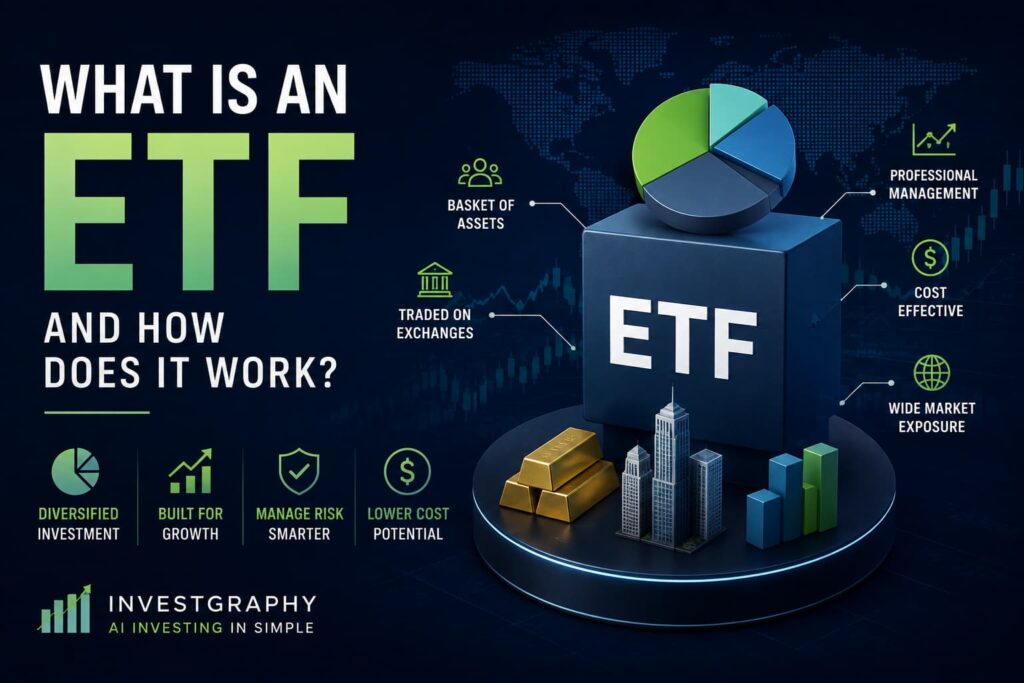
An ETF is a basket of stocks that trades like a single share. Buying QQQM with $100 means you own a tiny slice of all 100 companies in the NASDAQ 100 — including NVIDIA, Microsoft, Alphabet, Meta, and Amazon. If one company in the fund has a bad quarter, the others buffer the impact.
For most beginners, an ETF is the better first investment. You do not need to research individual companies. You do not need to decide whether NVIDIA is overvalued or AMD will catch up. You simply own the whole AI-relevant sector at once.
Option B — Individual AI Stocks
Individual stocks like NVIDIA, Microsoft, or Alphabet give you direct exposure to one company. The potential upside is higher if that company outperforms. The risk is also higher — one bad earnings report, one regulatory decision, one competitor announcement can drop a single stock significantly.
Analysts from FBB Capital Partners specifically advise beginners to stick with large-cap established names — NVIDIA, Microsoft, Alphabet, Amazon, Meta — rather than smaller AI companies with less revenue history and more uncertainty.
For a first $100, starting with an ETF and adding individual stocks later as you learn more is the more practical approach.
Step 3 — Place Your First Order
Once you have decided what to buy, placing an order takes under two minutes.
Open your brokerage app. Search for the ticker — QQQM for the Invesco NASDAQ 100 ETF, or NVDA for NVIDIA. Select the amount in dollars rather than shares — type $100. Choose a market order to buy at the current price. Confirm.
That is it. You now own a proportional slice of whatever you purchased.
One term worth understanding: a market order executes at whatever the current price is when the market is open. A limit order lets you set a maximum price you are willing to pay. For a beginner buying an ETF with $100, a market order is fine.
Step 4 — Keep Going With Dollar-Cost Averaging
The single most important thing you can do after your first $100 investment is invest another fixed amount next month. And the month after.
This strategy is called dollar-cost averaging — DCA. Instead of trying to time when the market is at its lowest, you invest a fixed amount at regular intervals regardless of price. When the price is high, your fixed amount buys fewer shares. When the price is low, it buys more. Over time, your average cost per share smooths out.
The research consistently supports DCA as more effective for most retail investors than attempting to time the market. In fact, one of the most consistent findings in retail investor behaviour data is that investors who try to time their entries tend to underperform those who invest steadily on a schedule.
You do not need to increase the amount. An extra $50 or $100 every month, consistently, builds meaningful exposure over years — without requiring you to watch the market daily.
What to Avoid as a Beginner
Three mistakes account for most of the money beginners lose in their first year.
Buying based on headlines. By the time an AI stock is making news, it has usually already moved significantly. Buying after a big run because you are afraid of missing out is one of the most common ways retail investors enter at the wrong price.
Spreading $100 across too many stocks. Ten different positions at $10 each is not diversification — it is complexity without benefit. One well-chosen ETF provides more real diversification than ten randomly selected stocks.
Checking the price daily. Short-term price movements in technology stocks are normal and often significant. A beginner who checks their $100 investment every day and panics at a 5% drop is far more likely to sell at a loss than someone who checks monthly and focuses on the long term.
FAQ
Can I really invest in AI with just $100?
Yes. Fractional shares allow you to invest any dollar amount in any US-listed stock or ETF regardless of its share price. Most major US brokerages including Fidelity, Charles Schwab, and Robinhood offer fractional shares with no minimum account balance and zero commission on trades. $100 is enough to get started — the amount matters far less than the habit of investing consistently.
What is the best way to invest $100 in AI as a beginner?
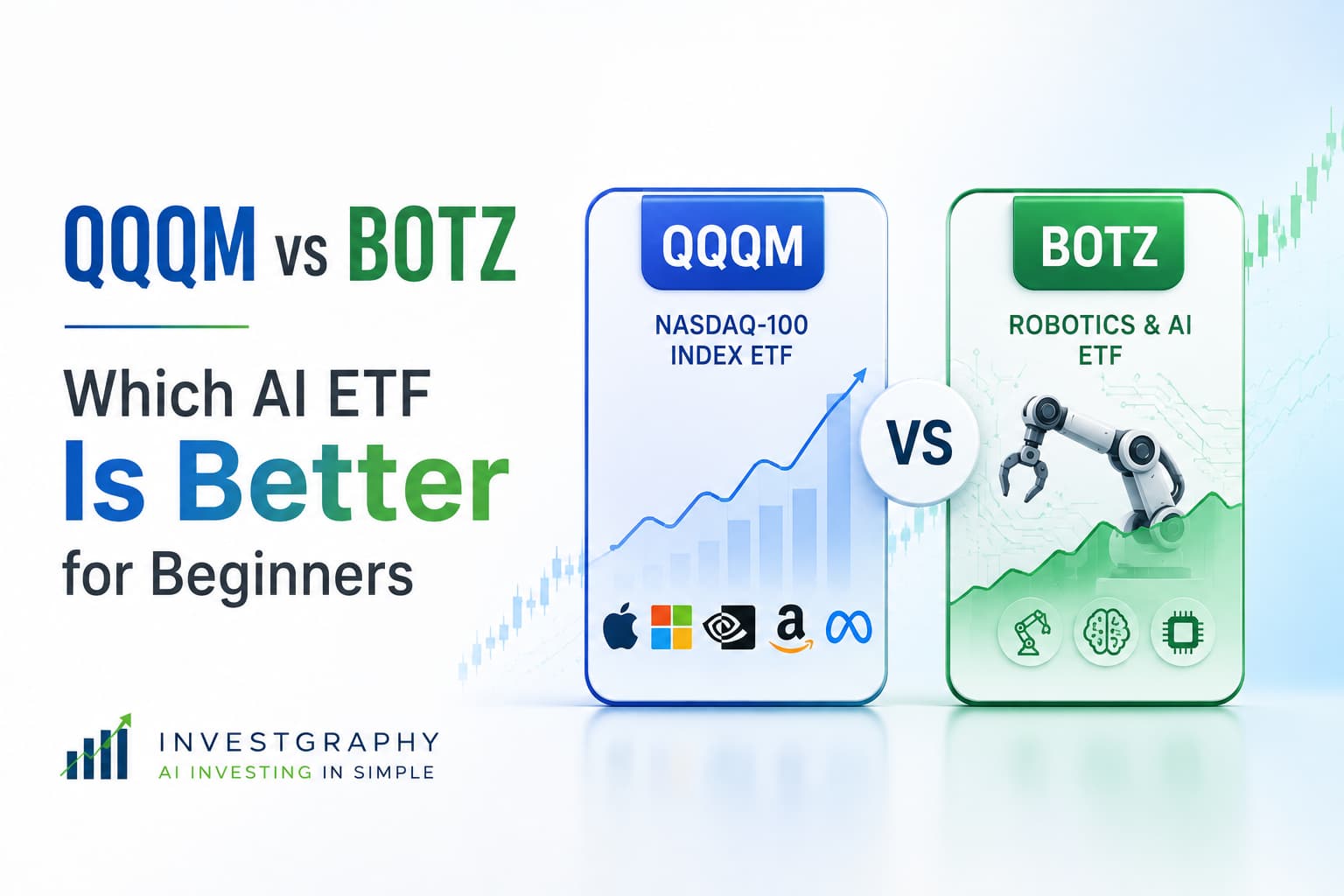
For most beginners, putting $100 into a broad technology or AI ETF like QQQM is more practical than picking individual stocks. QQQM tracks the NASDAQ 100, holds every major AI company as a top position, and charges only 0.15% in annual fees. It removes the need to research individual companies while still giving you meaningful exposure to the AI sector. This is not financial advice — always research before investing.
What is dollar-cost averaging and why do beginners use it?
Dollar-cost averaging means investing a fixed amount at regular intervals — for example $100 every month — regardless of what the market is doing. When prices are high your fixed amount buys fewer shares, and when prices are low it buys more. Over time this smooths your average cost and removes the pressure of trying to pick the perfect entry point. Most financial research suggests DCA produces better outcomes for retail investors than attempting to time the market.
Should I buy NVIDIA stock or an AI ETF first?
For a beginner starting with $100, an AI ETF is generally a more practical first investment than a single stock like NVIDIA. An ETF gives you exposure to NVIDIA and dozens of other AI companies at once, spreading the risk that any one company underperforms. Once you have a base position in a fund and have learned more about individual companies, adding a single stock like NVIDIA as a secondary position makes more sense. This is not financial advice — always do your own research.
Conclusion
The barrier to starting is no longer money. With fractional shares and zero-commission brokerages, $100 is genuinely enough to begin. The barrier is actually starting.
Open the account. Make the first deposit. Buy the ETF. Set a reminder to do it again next month. That sequence — repeated consistently — is how most long-term wealth in equity markets has historically been built.
The amount you start with matters far less than the decision to start.
Want a plain English breakdown of AI investing every week? Subscribe to the Investgraphy brief — free, five minutes, no hype.
Disclaimer
This article is for educational and informational purposes only and does not constitute financial advice. Brokerage features, commissions, and account minimums change frequently — always verify current terms directly with any brokerage before opening an account. Investing involves risk including possible loss of principal. Past market patterns do not guarantee future results. Always conduct your own research and consult a qualified financial advisor before making investment decisions.
About the Author
Investgraphy Team — Independent AI investing education for self-directed beginners. No hype, no jargon, no financial advice.