
Now Reading: QQQM vs BOTZ Which AI ETF Is Better for Beginners?
-
01
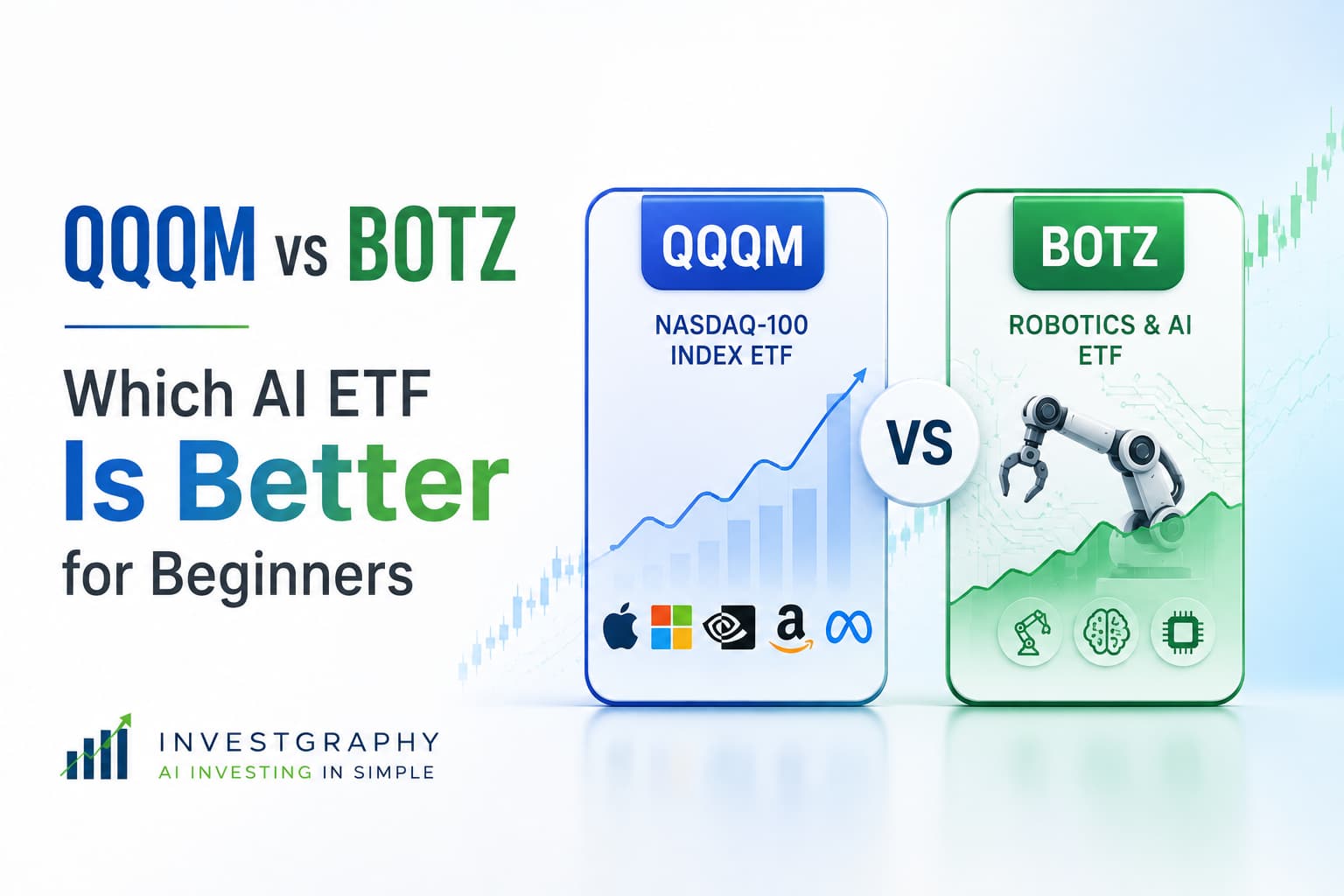
QQQM vs BOTZ Which AI ETF Is Better for Beginners?

Last Updated: May 2026 · 5 min read · AI ETFs
Key Takeaways
- QQQM tracks the NASDAQ 100 and returned 41.38% over the past year at a 0.15% expense ratio — the lowest cost option of the two
- BOTZ tracks robotics and AI hardware companies specifically, with a 0.68% expense ratio — 4.5x more expensive than QQQM
- Over five years, QQQM returned 13.37% annually versus just 0.69% annually for BOTZ
- BOTZ has stronger short-term momentum — up 14.86% over the past six months — but its long-term track record significantly trails QQQM
- For most beginners, QQQM is the more practical starting point — BOTZ is better as a secondary, specialist position once you understand what it holds
QQQM is the lower-cost, broader fund with a stronger long-term performance record — it returned 41.38% over the past year at a 0.15% expense ratio. BOTZ is a specialist fund focused on robotics and AI hardware with a 0.68% expense ratio and a weaker five-year track record of 0.69% annually versus QQQM’s 13.37%. For a beginner choosing one first AI ETF, QQQM is the more practical choice. BOTZ makes more sense as a secondary position for investors who specifically want robotics and physical AI hardware exposure.
What Each Fund Actually Holds
The two funds are built on fundamentally different philosophies — and understanding that difference is the only thing that matters when comparing them.
QQQM tracks the NASDAQ 100 index — the 100 largest non-financial companies listed on the NASDAQ exchange. Its top five holdings are NVIDIA at 8.2%, Apple at 7.2%, Microsoft at 5.3%, Amazon at 5.1%, and Alphabet at 3.9%. In total it holds 102 companies. It is not a pure AI fund — it is the broadest technology index that happens to be dominated by every major AI company in existence.
BOTZ tracks the Indxx Global Robotics and Artificial Intelligence Thematic Index — a specialist index of roughly 50 companies directly involved in robotics, automation, and AI hardware. Its top holdings include NVIDIA, Keyence Corporation, ABB Ltd, FANUC, and Mitsubishi Electric. It has a notable tilt toward Japanese industrial robotics companies, meaning a meaningful portion of the fund sits outside the US technology sector entirely.
The overlap matters: both funds hold NVIDIA as a top position. But beyond that single holding, they are very different bets on very different parts of the AI economy.
Performance — The Numbers Side by Side
This is where the comparison becomes straightforward.
| Metric | QQQM | BOTZ |
| Expense ratio | 0.15% | 0.68% |
| AUM | $69.86 billion | $3.56 billion |
| 1-year return | +41.38% | Not disclosed |
| 6-month return | Not disclosed | +14.86% |
| 5-year annual return | 13.37%/yr | 0.69%/yr |
| Number of holdings | 102 | ~50 |
| Primary market | US large cap tech | Global robotics/AI hardware |
The five-year comparison is the most honest measure available. Over five years, QQQM returned 13.37% per year on average. BOTZ returned 0.69% per year over the same period.
That gap is not close. An investor who put $10,000 into QQQM five years ago would have significantly more today than one who put the same amount into BOTZ.
BOTZ has shown stronger momentum over the past six months — up 14.86% — which reflects recent demand for physical AI infrastructure, robotics, and industrial automation. Whether that short-term momentum continues is something nobody can predict with certainty.
The Cost Difference Compounds Over Time
The expense ratio difference between QQQM and BOTZ is 0.53 percentage points — 0.15% versus 0.68%. That sounds small. Over a decade it is not.
On a $10,000 investment growing at 10% annually, the difference between paying 0.15% and 0.68% in fees over 10 years amounts to roughly $900 in lost returns — money that never compounds because it was paid in fees instead.
Invesco, the fund manager behind QQQM, states that its 0.15% expense ratio is 77% lower than its peer group median. This matters for a long-term buy-and-hold investor more than almost any other factor.
BOTZ charges 0.68% for a specialist exposure that, over five years, returned far less than QQQM’s broader approach. For the additional cost to make sense, BOTZ would need to consistently outperform QQQM by more than its additional fee — something its historical track record has not demonstrated.
When BOTZ Makes Sense
BOTZ is not a bad fund. It is a specific fund designed for a specific purpose. There are three situations where it makes more sense than QQQM.
You already hold QQQM and want additional exposure to the robotics and physical AI hardware layer specifically. The two funds have enough different holdings that combining them adds meaningful diversification beyond what QQQM alone provides.
You have a specific conviction that industrial robotics and automation — particularly in Japan and other non-US markets — will outperform broad US technology over the next five to ten years. BOTZ gives you that targeted exposure.
You understand that you are accepting a weaker historical performance record in exchange for concentration in a specific AI sub-theme. That is a legitimate investment decision for someone who has done the research — it is not the right default starting point for a beginner making their first investment.
The Honest Summary
QQQM wins on cost, diversification, AUM size, and long-term performance track record. It is the safer, simpler, more practical choice for a beginner who wants AI and technology exposure without complexity.
BOTZ wins on specialist focus and recent short-term momentum. It is a reasonable secondary position for someone who understands what industrial robotics and physical AI hardware is — and who specifically wants more of it than QQQM provides.
The comparison is not close enough to justify BOTZ as a first investment over QQQM. If you only own one fund, it should be the one with the lower cost, more holdings, more assets under management, and stronger long-term performance record.
FAQ
Is QQQM or BOTZ better for a beginner investor?
For most beginners, QQQM is the better starting point. It has a 0.15% expense ratio — 77% below the peer group median — holds 102 companies including every major AI stock, and has returned 13.37% annually over five years. BOTZ has returned 0.69% annually over the same period at a 0.68% expense ratio. Unless you have a specific reason to want robotics and industrial AI hardware exposure, QQQM is the more practical first AI ETF. This is not financial advice — always do your own research.
Do QQQM and BOTZ hold the same stocks?
They share NVIDIA as a top holding in both funds. Beyond that they are largely different. QQQM holds 102 large-cap US technology companies including Apple, Microsoft, Amazon, and Alphabet. BOTZ holds roughly 50 companies focused on robotics and physical AI hardware, with significant exposure to Japanese industrial companies like Keyence and FANUC. The 0.78 correlation between BOTZ and QQQ means the two funds move somewhat together — but not identically.
What is the difference between QQQ and QQQM?
QQQ and QQQM track the exact same index — the NASDAQ 100 — and hold the identical 102 companies. The only meaningful difference is cost and share price. QQQM charges 0.15% versus QQQ’s 0.18% annually. QQQM trades at a lower price per share — around $248 versus QQQ’s $604 — making it more accessible for investors starting with smaller amounts. The Motley Fool noted in May 2026 that most long-term investors are better off buying QQQM rather than QQQ for this reason.
Can I hold both QQQM and BOTZ at the same time?
Yes — and for investors who want both broad technology exposure and targeted physical AI hardware coverage, holding both is a reasonable approach. The key is understanding that both funds hold NVIDIA as a top position, so you will have double exposure to that single stock. Beyond NVIDIA, the holdings are different enough that combining the two adds real diversification across different parts of the AI economy. Size your BOTZ position smaller than your QQQM position given the cost and track record differences.
Conclusion
This comparison has a clear winner on the data available today. QQQM costs less, holds more companies, manages more assets, and has delivered significantly better long-term returns than BOTZ.
That does not make BOTZ wrong — it makes it specialist. The right fund for a beginner is the one that is simple, low-cost, and diversified. QQQM fits that description more cleanly than any other AI-adjacent ETF currently available.
Start with QQQM. Add BOTZ later if you develop a specific view on robotics and industrial AI that you want more exposure to.
Want clear comparisons like this every week? Subscribe to the Investgraphy brief — free, five minutes, no hype.
Disclaimer
This article is for educational and informational purposes only and does not constitute financial advice. All performance figures and fund data are sourced from TipRanks, PortfoliosLab, ETF Database, Invesco, and Motley Fool as of May 2026. ETF data changes frequently — always verify current figures before making investment decisions. Past performance does not guarantee future results. Investing involves risk including possible loss of principal. Always conduct your own research and consult a qualified financial advisor.
About the Author
Investgraphy Team — Independent AI investing education for self-directed beginners. No hype, no jargon, no financial advice.