
Now Reading: What Is NVIDIA Stock and Why Do AI Investors Care?
-
01
What Is NVIDIA Stock and Why Do AI Investors Care?

Last Updated: May 2026 · 6 min read · AI Stocks
Key Takeaways
- NVIDIA reported $81.6 billion in revenue for a single quarter ending April 2026 — up 85% from the same quarter a year ago
- Data center revenue alone hit $75.2 billion that quarter — meaning AI infrastructure is now 92% of NVIDIA’s total business
- NVIDIA makes the GPUs that power virtually every major AI model in the world — from ChatGPT to Google Gemini
- The company’s Blackwell chip platform is currently in full-scale production with demand described by its CEO as “extraordinary”
- Understanding what NVIDIA actually does is the single most important foundation for any beginner AI investor
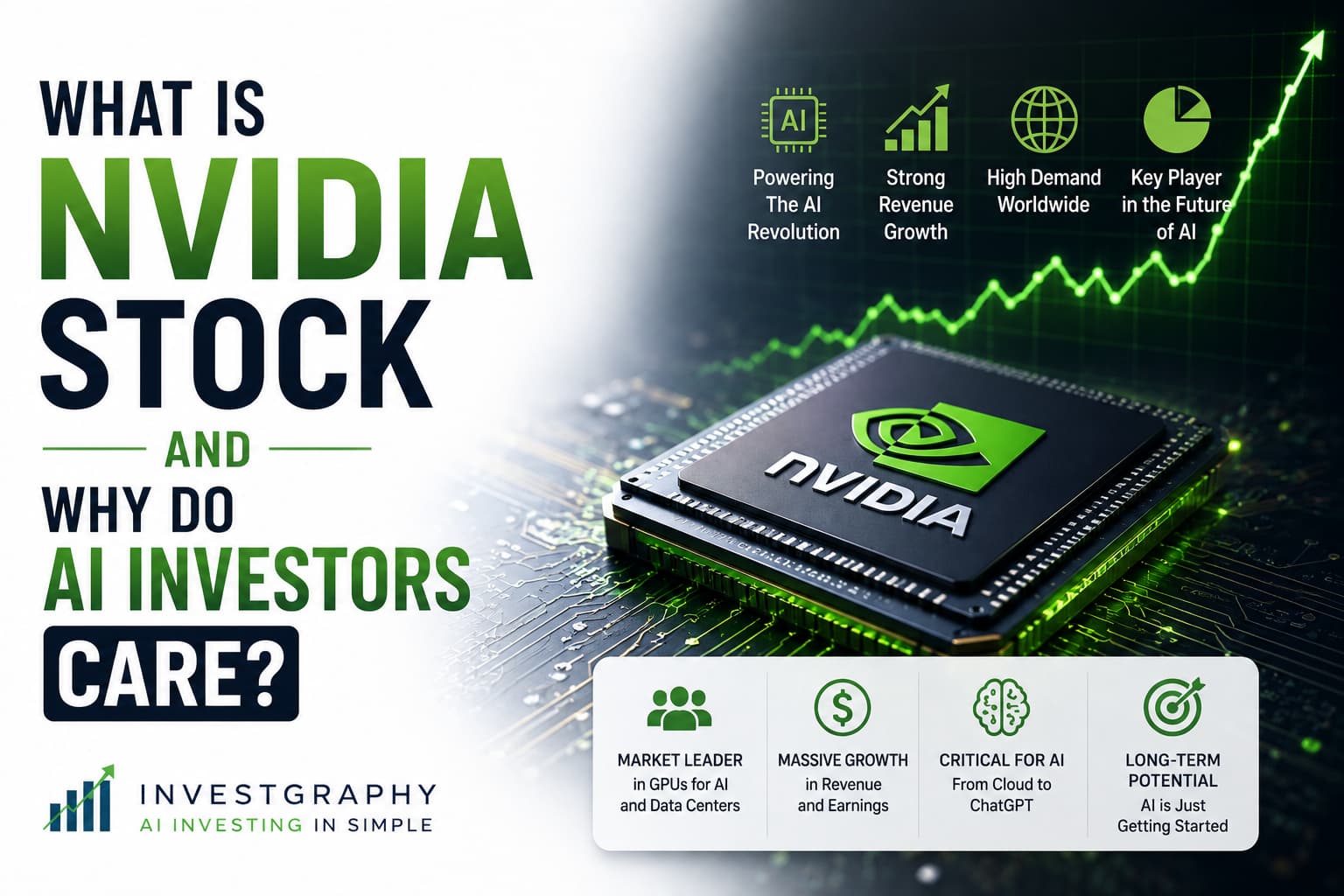
NVIDIA is a semiconductor company that designs the graphics processing units — GPUs — that power almost every major AI system in the world. Its stock trades on NASDAQ under the ticker NVDA. In the quarter ending April 2026, NVIDIA reported $81.6 billion in revenue — up 85% from a year earlier — with data center revenue of $75.2 billion making up 92% of its total business. Every time an AI model processes a request anywhere in the world, it almost certainly runs on NVIDIA hardware.
What NVIDIA Actually Makes
NVIDIA designs chips. Specifically, it designs a type of chip called a GPU — a graphics processing unit. GPUs were originally built to render video game graphics, which requires processing thousands of calculations simultaneously. That same parallel processing capability turned out to be exactly what AI needs.
Training an AI model — teaching it to understand language, generate images, or reason through problems — requires performing billions of calculations at the same time, repeatedly, for weeks. A CPU, the standard processor in a laptop or desktop, handles tasks one by one. A GPU handles thousands at once. For AI, that difference is the entire ballgame.
NVIDIA does not manufacture its chips. It designs them and outsources manufacturing to TSMC in Taiwan. This is an important distinction — NVIDIA’s value is in its chip architecture, software ecosystem, and the decade of AI-specific development it has accumulated, not in owning physical factories.
The Numbers That Explain Everything
On May 20, 2026, NVIDIA reported its financial results for the quarter ending April 26, 2026. The figures came directly from its SEC filing:
Total revenue: $81.6 billion — a record, up 85% from a year ago and up 20% from the previous quarter.
Data center revenue: $75.2 billion — up 92% from a year ago. This single segment, which covers the GPUs sold to AI data centers and cloud providers, now represents 92% of NVIDIA’s entire business.
To put that in perspective: NVIDIA’s data center revenue in one quarter is larger than the annual revenue of most companies in the S&P 500.
The company also announced an $80 billion share repurchase authorisation and increased its quarterly dividend from $0.01 to $0.25 per share — signals that the business generates more cash than it currently needs to reinvest.
Why Every AI Model Depends on NVIDIA
When OpenAI trains a new version of ChatGPT, it runs on NVIDIA GPUs — typically in data centers operated by Microsoft Azure. When Google trains Gemini, it runs on a combination of its own TPU chips and NVIDIA hardware. When Meta builds its Llama models, NVIDIA GPUs are central to the infrastructure.
This is not a coincidence. NVIDIA has spent over a decade building CUDA — a software platform that allows developers to write code specifically optimised for NVIDIA’s chips. The result is that almost all AI research and development tooling, frameworks, and libraries are written for CUDA. Switching away from NVIDIA hardware means rewriting enormous amounts of code.
This software lock-in is arguably more valuable than the hardware itself. It is why NVIDIA maintains dominant market share in AI data center GPUs even as competitors like AMD and Intel develop rival chips. The hardware competition is real — the software ecosystem moat is what keeps customers on NVIDIA’s platform.
NVIDIA’s Current Chip Platform — Blackwell
NVIDIA’s current product generation is called Blackwell. Its CEO Jensen Huang described Blackwell as the platform designed for “reasoning AI” — the next stage of AI development where models do not just generate text but think through complex multi-step problems.
Blackwell is in full-scale production as of early 2026. In Q4 of NVIDIA’s fiscal year 2025, the company delivered $11 billion in Blackwell revenue in its first quarter of availability — described by the company as the fastest product ramp in its history. By Q1 fiscal 2027 — the quarter ending April 2026 — Blackwell had become the primary driver of record data center revenue.
The successor platform, Vera Rubin, is already in development. NVIDIA has historically released a new chip architecture every one to two years, maintaining a product cadence that keeps it ahead of competitors who are still catching up to the previous generation.
What Beginners Should Understand Before Buying NVIDIA
NVIDIA is not a cheap stock by any conventional valuation measure. A company generating $81.6 billion in quarterly revenue is already enormous — and its stock price reflects expectations of continued growth at a pace that very few companies in history have sustained.
There are three things a beginner should understand before considering NVIDIA as an investment.
First, the competitive risk is real. Amazon, Google, and Microsoft are all developing their own custom AI chips — Amazon’s Trainium, Google’s TPU, Microsoft’s Maia. As hyperscalers build in-house silicon, their long-term dependency on NVIDIA may gradually decrease. NVIDIA’s CEO has acknowledged this directly.
Second, geopolitical risk is significant. The US government has imposed export restrictions on NVIDIA’s most advanced chips to China. In Q1 fiscal 2026, NVIDIA was unable to ship $2.5 billion in H20 chip revenue due to these restrictions — a $4.5 billion total charge to the quarter. If US-China trade policy tightens further, NVIDIA’s revenue could be materially affected.
Third, the current revenue trajectory, while extraordinary, is priced into the stock. A company does not post 85% year-over-year revenue growth forever. The question for any investor is not whether NVIDIA is a great company — it clearly is — but whether the stock price at any given moment already reflects everything great about it.
FAQ
What does NVIDIA actually do?
NVIDIA designs graphics processing units — GPUs — that are used to run AI models in data centers worldwide. The company does not manufacture its chips directly, outsourcing production to TSMC in Taiwan. Beyond hardware, NVIDIA’s CUDA software platform has become the dominant development environment for AI research, creating a software ecosystem that makes switching to competitor chips costly for most AI developers.
Why is NVIDIA important to AI investors?
NVIDIA supplies the hardware that virtually every major AI system runs on. Its data center revenue hit $75.2 billion in the quarter ending April 2026 — up 92% year over year. Because AI model training and inference both depend heavily on GPU compute, NVIDIA benefits directly from every dollar spent on AI infrastructure. The five largest US tech companies committed over $650 billion to AI infrastructure spending in 2026 — and a significant portion of that flows to NVIDIA.
Is NVIDIA a good stock for beginners?
NVIDIA is one of the most widely covered and analysed stocks in the market. For a beginner, that means there is no shortage of research available. The risk is that its valuation already reflects significant future growth — buying a stock after it has already appreciated dramatically is different from buying it early. Beginners should understand what they are buying, at what price, and why before investing in any individual stock including NVIDIA. This is not financial advice — always do your own research.
What is NVIDIA’s ticker symbol and where does it trade?
NVIDIA trades on the NASDAQ stock exchange under the ticker symbol NVDA. It is a component of the NASDAQ 100 index — meaning funds like QQQM, which track the NASDAQ 100, include NVIDIA as a top holding. Investors who hold QQQM already have indirect exposure to NVIDIA without owning the stock directly.
Conclusion
NVIDIA is not a bet on which AI app wins. It is a bet on whether AI infrastructure spending continues — and the evidence for that, backed by $81.6 billion in quarterly revenue and $650 billion in committed hyperscaler capex, is as concrete as financial evidence gets.
Understanding what NVIDIA does, how it makes money, and what risks it carries is the foundation for understanding AI investing more broadly. Every other AI infrastructure company exists in a stack that NVIDIA currently sits at the center of.
Want clear AI investing breakdowns every week? Subscribe to the Investgraphy brief — free, five minutes, no hype.
Disclaimer
This article is for educational and informational purposes only and does not constitute financial advice. All financial figures are sourced directly from NVIDIA’s SEC filings as reported on May 20, 2026. Investing involves risk including possible loss of principal. Stock prices and company performance can change significantly. Always conduct your own research and consult a qualified financial advisor before making investment decisions.
About the Author
Investgraphy Team — Independent AI investing education for self-directed beginners. No hype, no jargon, no financial advice.