
Now Reading: 7 AI Investing Mistakes Beginners Make And How to Avoid Them
-
01
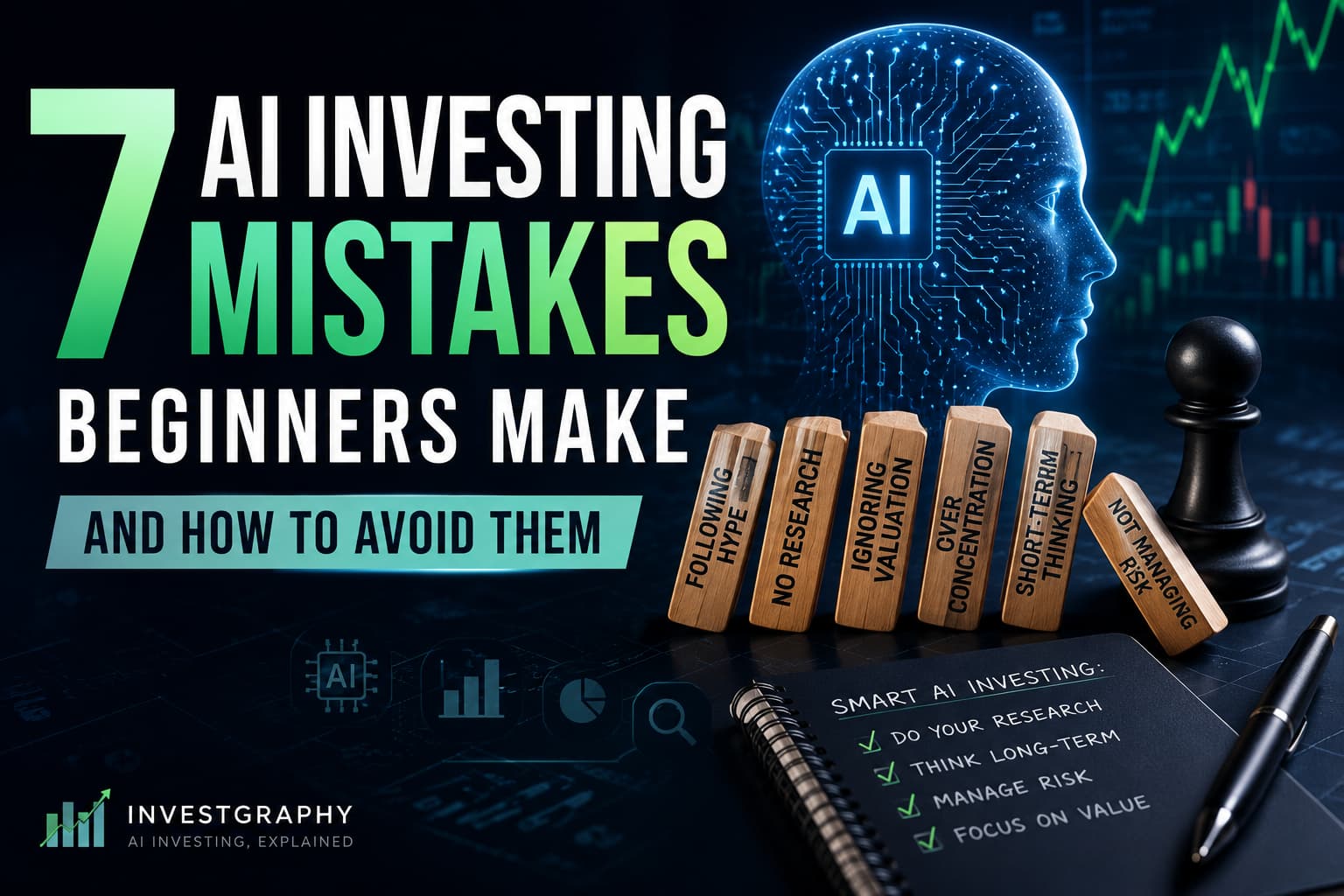
7 AI Investing Mistakes Beginners Make And How to Avoid Them

Last Updated: May 2026 · 6 min read · Investor Mindset
Key Takeaways
- Most beginners lose money in AI investing not by picking the wrong company but by making structural mistakes before they even buy anything
- The biggest single mistake, identified by analysts at Motley Fool, Saxo, and Wendy Li of Ivy Invest, is buying based on headlines and selling during drawdowns
- Concentrating in one part of the AI value chain creates hidden correlation risk: owning NVIDIA, Broadcom, and AMD together is less diversified than it appears because all three share the same major customers
- Ignoring expense ratios across multiple AI ETFs can cost thousands of dollars over a decade even if the underlying performance is identical
- The investor who holds through volatility with a position they understand almost always outperforms the one who traded their way into the same result
The most common AI investing mistakes beginners make are not about picking the wrong stock. They are about entering at the wrong time for the wrong reason, building a portfolio that looks diversified but is not, paying fees they never noticed, misunderstanding what they actually own, and selling during the exact moments they should be holding. This article covers seven specific mistakes, why each one happens, and what to do instead, before you put any money in.
Mistake 1: Buying the Headline, Not the Company
The most consistent mistake across every type of retail investor, not just AI beginners, is buying based on what is in the news rather than what the business actually does and how it makes money.
When NVIDIA became front-page news in 2023 and 2024, millions of retail investors bought in. Many did so without understanding that NVIDIA designs chips rather than manufacturing them, that its pricing power comes primarily from its CUDA software ecosystem rather than raw hardware performance, or that its stock was already pricing in several years of extraordinary growth at the point it became a household name.
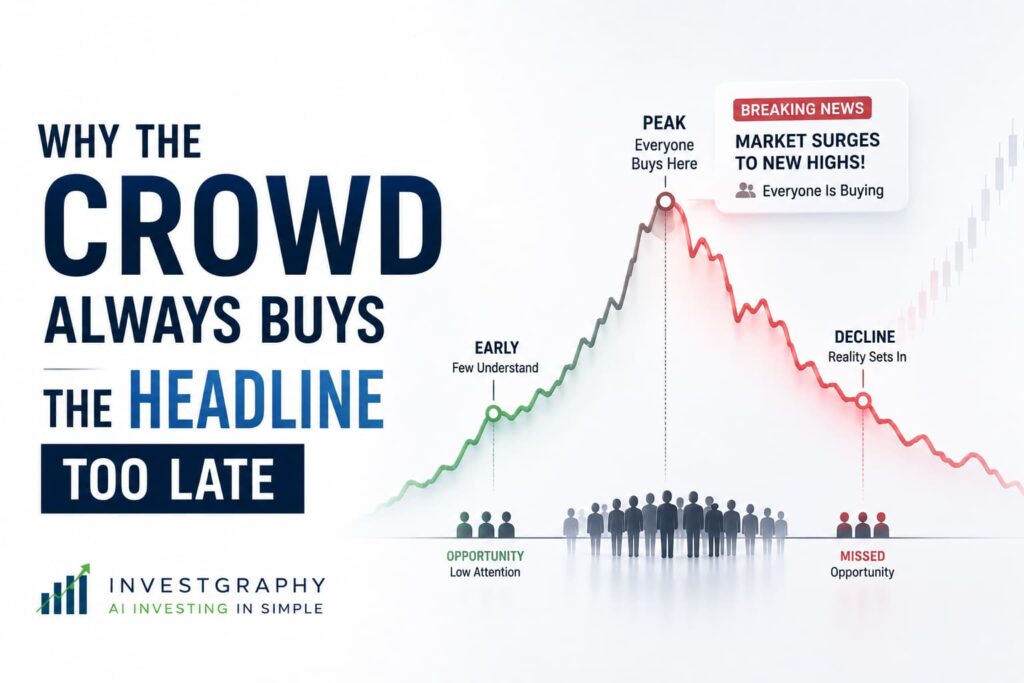
Buying a stock because it is famous is not an investment thesis. It is a momentum trade dressed up as conviction. The two feel identical at the start, and lead to completely different outcomes when volatility arrives.
Before buying any AI stock or ETF, ask one question: can you explain in two sentences what this company does and why it makes money? If the answer is no, that is the mistake you are about to make.
→ See: What Is NVIDIA Stock and Why Do AI Investors Care?
Mistake 2: Thinking You Are Diversified When You Are Not
This is the subtlest mistake on this list and the one most likely to surprise an investor during a downturn.
An investor who owns NVIDIA, Broadcom, and AMD might feel they have spread their AI chip risk across three companies. They have not. All three companies share the same largest customers: Microsoft, Google, Amazon, Meta, and OpenAI. If any major hyperscaler significantly cuts its AI capital expenditure, all three stocks can fall simultaneously. Owning three companies with identical customer bases is concentration dressed up as diversification.
The same logic applies to AI ETFs. An investor who holds QQQM, AIQ, and BOTZ simultaneously probably has NVIDIA in all three funds. Adding a second or third AI ETF does not reduce exposure to NVIDIA. It increases it while also increasing the fee burden across multiple fund expense ratios.
True diversification in AI means exposure across different parts of the value chain: chips, data centers, power infrastructure, cloud providers, and broad market indices that include non-AI sectors entirely. Owning three chip stocks or three tech-heavy ETFs is not that.
→ See: Best AI ETFs for Beginners in 2026 and Why AI Runs on Electricity: The Energy Stocks Nobody Talks About
Mistake 3: Ignoring Expense Ratios Across Multiple Funds
Most beginners focus on which fund has performed best recently. Almost none of them calculate what they are actually paying across multiple fund holdings.
A 0.15% expense ratio on QQQM sounds almost free. Add a 0.68% BOTZ position and a 0.75% CHAT position alongside it and your blended fee across those three holdings could average 0.40% or higher, depending on how much you put into each. On a $20,000 portfolio growing at 8% annually, the difference between paying 0.15% and 0.40% in blended fees over 20 years is approximately $8,000 in lost compounding.
That is not a rounding error. That is real money that never compounded because it was paid silently in fees every year.
The fix is simple: calculate your blended expense ratio across every fund you hold. Weight each fund’s expense ratio by the percentage of your portfolio it represents and add them up. If the number is above 0.25%, ask whether the additional specialist exposure in your more expensive funds is worth the cost difference compared to holding more of the cheaper core fund.
→ See: What Is an ETF and How Does It Work? and Compound Interest Explained Simply: With Real Numbers
Mistake 4: Treating AI Stocks as a Short-Term Trade
Financial experts including Wendy Li, Chief Investment Officer of Ivy Invest, have identified FOMO combined with volatility as the worst possible combination for retail investors, because it creates conditions where people buy high and sell low consistently.
AI stocks are among the most volatile in the market. QQQM fell 32.52% in 2022. Individual AI stocks have experienced single-day swings of 10% or more on earnings reports. A beginner who buys because prices are rising and sells because prices are falling is not investing. They are systematically transferring wealth to the investors on the other side of those trades.
The structural truth is that AI infrastructure spending is locked in for years through signed contracts. The five largest US hyperscalers committed over $650 billion in capital expenditure for 2026. That spending does not reverse based on a single bad quarter or a negative headline. An investor with a five to ten year horizon and a position they understand has no rational reason to sell during a short-term drawdown in a business whose fundamentals remain intact.
Buying AI stocks in the hopes of a quick return is, as Motley Fool’s analysts put it directly, “a great way to lose your shirt.”
→ See: Why The Crowd Always Buys the Headline Too Late and What Is Dollar-Cost Averaging and Does It Actually Work?
Mistake 5: Focusing Only on the App Layer
Most beginner investors think about AI investing in terms of AI apps: ChatGPT, Gemini, Copilot, Claude. These are the products they interact with daily, so they instinctively assume that is where the investment opportunity is.
The app layer is the most competitive, lowest-margin part of the AI stack. Consumer AI apps compete on features and price, which drives margins down over time. The infrastructure layer, the chips running these apps, the data centers housing the chips, the power systems feeding the data centers, operates with the opposite dynamic. Every new AI app that launches adds demand to the infrastructure layer regardless of which app wins.
Institutional investors understood this early. Most of the $581.7 billion in global corporate AI investment in 2025 went to infrastructure, not to consumer applications. Beginners who focus exclusively on the apps are often looking at the lowest-return part of the investment opportunity.
→ See: Why AI Money Isn’t in the App: It’s in the Infrastructure and The Real Winners of Every Tech Boom Sell the Shovels
Mistake 6: Overreacting to Geopolitical Headlines
US-China trade tensions and semiconductor export restrictions generate dramatic headlines that frequently move AI stock prices significantly in a single day. Beginners who do not understand the underlying business often interpret these moves as signals to buy or sell immediately.
The reality is more nuanced. Export restrictions on NVIDIA’s most advanced chips to China cost the company $4.5 billion in charges in Q1 fiscal 2026. That is a real and meaningful impact. It is also a risk that NVIDIA disclosed, that analysts had modeled, and that the company’s overall revenue trajectory absorbed without derailing the broader business, which still grew 85% year over year in the same period.
A single geopolitical headline does not change the multi-year AI infrastructure investment thesis. It may change the short-term price of individual stocks significantly. Treating a 10% single-day drop driven by a trade headline as a fundamental change in a business’s long-term value, and selling because of it, is exactly how retail investors lock in losses that patient investors recover from within months.
Mistake 7: Not Understanding What You Own Before You Buy It
This is the mistake that makes every other mistake on this list worse.
An investor who understands that NVIDIA designs chips rather than manufacturing them, that its competitive moat is primarily software rather than hardware, and that its largest risk is custom silicon from its own customers, that investor can make a rational decision about how much to own, when to buy more, and when a negative headline actually matters versus when it is noise.
An investor who bought NVIDIA because it was in the news and the price was going up has no framework for any of those decisions. They are flying blind in a volatile aircraft, and the first turbulence sends them reaching for the exit.
The fix is not complicated. Before buying any AI position, stock or ETF, spend 30 minutes reading what the company or fund actually does, how it makes money, who its customers are, and what could genuinely hurt the business. Not a financial article. The company’s own investor relations page. One page of the annual report. The fund’s top 10 holdings list. That 30 minutes is the difference between an investment and a bet.
→ See: AI Investing for Beginners: The Complete Guide
FAQ
What is the most common AI investing mistake beginners make?
The most common mistake is buying based on news headlines rather than understanding the underlying business: entering after a significant price run because of FOMO, without a clear thesis for why the company makes money or what could genuinely change that. This is compounded by selling during the first significant drawdown, which locks in losses that a patient, informed investor would have recovered from. Understanding what you own before you buy it prevents most of the other mistakes on this list.
Is owning multiple AI ETFs good diversification?
Not necessarily. Many AI ETFs share the same top holdings, particularly NVIDIA, Microsoft, and Alphabet. Holding QQQM, AIQ, and BOTZ simultaneously may increase your NVIDIA exposure significantly while also increasing your blended expense ratio. True diversification means exposure across different parts of the AI value chain, chips, infrastructure, power, and broader market indices, not multiple funds that concentrate in the same companies through different wrappers.
Should I sell AI stocks when prices drop?
Whether to sell during a price drop depends entirely on whether the reason you originally bought the position still holds. If the underlying business fundamentals remain intact, earnings are growing, the customer base is expanding, the competitive position is unchanged, a short-term price decline driven by market sentiment or geopolitical headlines is generally not a reason to sell. Selling at a loss during a drawdown that subsequently reverses is one of the most consistent ways retail investors underperform the broader market over time.
How much of a portfolio should a beginner allocate to AI stocks?
There is no universal answer. It depends on your age, time horizon, income, other investments, and risk tolerance. What most financial educators suggest for beginners is that a concentrated thematic bet like individual AI stocks should represent a smaller portion of a broader portfolio that includes diversified index funds. Starting with a broad technology or market ETF that already includes AI companies as top holdings gives meaningful AI exposure without requiring you to size a concentrated position before you understand the space well. This is not financial advice; always consult a financial advisor.
Every mistake on this list has one thing in common: it is driven by emotion or ignorance rather than analysis. Buying because of headlines, selling because of fear, holding fake diversification, ignoring fees: none of these require bad luck to happen. They require only that an investor never stops to ask basic questions about what they own and why.
The good news is that fixing these mistakes requires no special skill or insight. It requires only the habit of understanding before buying, calculating before allocating, and holding when the thesis remains intact.
Most investors who consistently avoid these seven mistakes do not need to pick the perfect AI stock. They just need to stay in the game long enough for the infrastructure buildout to compound.
Want a clear AI investing breakdown every week, without the mistakes? Subscribe to the Investgraphy brief: free, five minutes, no hype.
← Back to the complete guide: AI Investing for Beginners
This article is for educational and informational purposes only and does not constitute financial advice. References to Motley Fool, Saxo, and Ivy Invest analysis are for informational purposes only. Investing involves risk including possible loss of principal. Past market behavior does not guarantee future results. Always conduct your own research and consult a qualified financial advisor before making investment decisions.
About the Author
Investgraphy Team: Independent AI investing education for self-directed beginners. No hype, no jargon, no financial advice.