
Now Reading: How to Build an AI Portfolio Step by Step
-
01
How to Build an AI Portfolio Step by Step
- Home
- Investing Basics
- How to Build an AI Portfolio Step by Step
How to Build an AI Portfolio Step by Step

Last Updated: May 2026 · 6 min read · Investing Basics
- A beginner AI portfolio does not need more than two to three funds to be properly constructed.
- Investors adding a dedicated AI ETF on top of a broad market fund can end up with 25–35% effective AI concentration without realising it.
- The Magnificent Seven represent roughly a third of S&P 500 market cap, and five are direct AI beneficiaries, meaning almost any broad US equity fund already carries significant AI exposure.
- Asset allocation drives approximately 90% of long-term portfolio returns, making the split between broad and thematic holdings more important than which specific fund you choose.
- Investors with a 10+ year horizon can hold more AI; those approaching retirement should limit AI exposure to 10–15% of total portfolio.
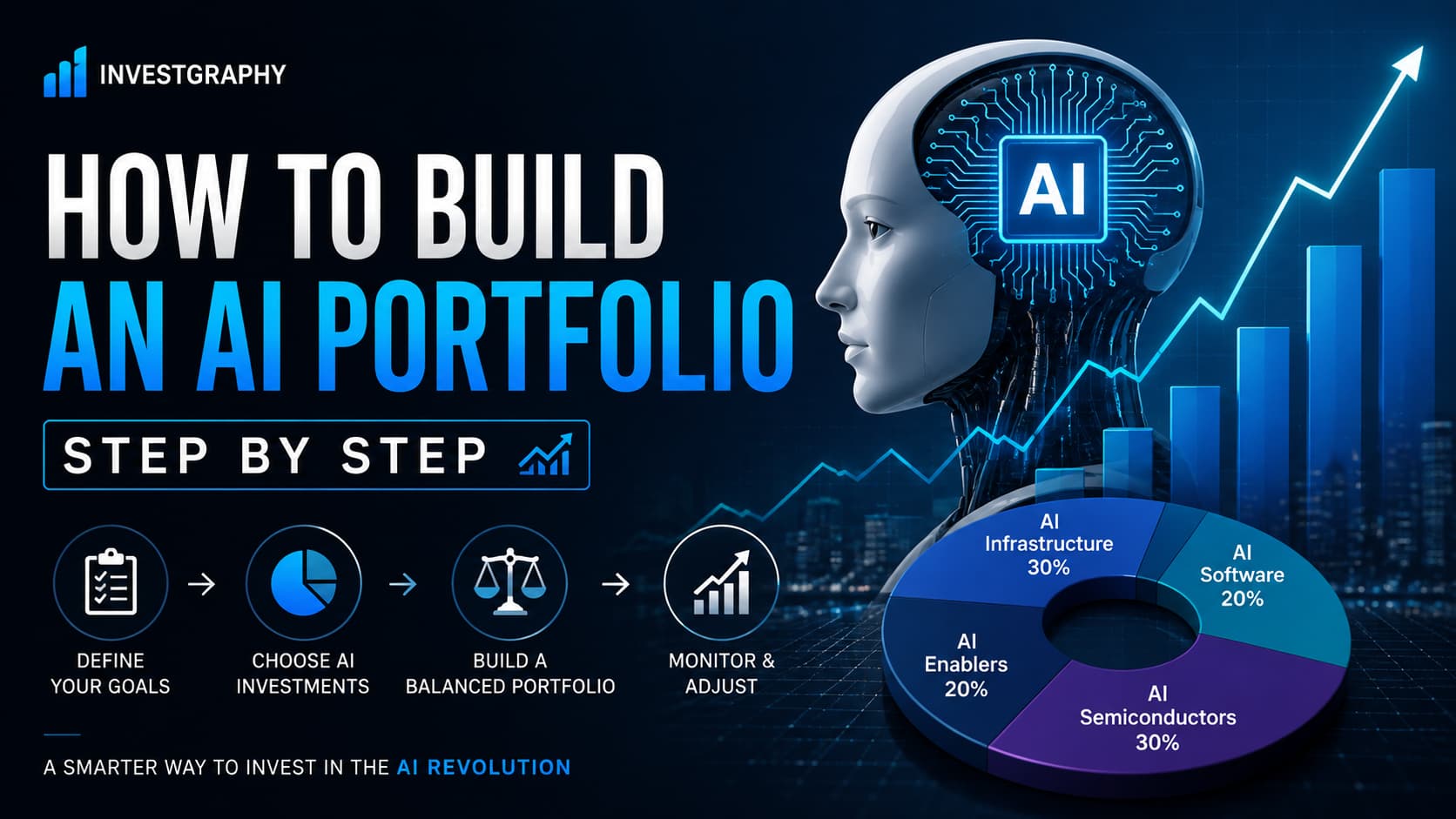
Building an AI portfolio as a beginner involves four steps: auditing what AI exposure you already have, deciding how much to allocate to AI as a theme, selecting one or two funds that cover different parts of the value chain without excessive overlap, and contributing consistently on a schedule rather than trying to time your entries. Most beginners significantly overcomplicate this by buying multiple AI funds before checking whether they already own the same companies through a broad market index.
Step 1 Audit What You Already Own
Before adding any AI-specific position, spend five minutes checking what you already own.
As of early 2026, the Magnificent Seven (Apple, Microsoft, Alphabet, Amazon, Meta, NVIDIA, and Tesla) represent roughly a third of S&P 500 market capitalisation. Five of those seven are direct AI beneficiaries. Any investor already holding a standard S&P 500 fund like VOO has meaningful AI exposure before buying anything else.
An investor who holds a 60% allocation to a broad US equity fund and adds a 10% dedicated AI ETF on top often ends up with 25–35% effective AI exposure once you look through to the actual underlying holdings. That is a very concentrated thematic bet that most investors didn't plan deliberately.
Step 2 Decide Your AI Allocation
There is no universally correct percentage to allocate to AI as a theme. The right number depends on your age, time horizon, overall financial situation, and tolerance for volatility.
For investors with a time horizon of 10 or more years, a higher allocation to growth-oriented AI positions is more defensible, as there is time to recover from any significant drawdown. For investors within five to ten years of needing their money, most financial guidance suggests limiting exposure to a concentrated theme like AI to 10–15% of the total portfolio.
The Legacy Investing Show's 2026 guide describes this as a core plus satellite approach: broad diversified funds form the foundation, and AI represents a measured satellite position. In practice, this often means 70–80% in a broad low-cost index fund and 20–30% in a specific AI or semiconductor fund, not the reverse.
The starting amount matters less than the structure. Whether you begin with $500 or $5,000, the allocation logic is the same.
Step 3 Choose Your Funds Without Overlapping
Once you know your allocation, fund selection is simpler than most beginners expect, as long as you check for overlap first.
A practical two-fund AI portfolio looks like this. The first position is a broad low-cost technology or market fund, such as QQQM (0.15% expense ratio) or VOO (0.03%). This gives you diversified AI exposure across NVIDIA, Microsoft, Alphabet, Amazon, and Meta without concentration in a single company. The second position, if you add one, targets a specific part of the AI value chain that the core fund underweights.
AI Capital Wire's 2026 analysis recommends semiconductor funds like SMH or SOXX as a core AI position at 0.34–0.35% expense ratio, providing direct exposure to NVIDIA, TSMC, Broadcom, and ASML at lower cost than many AI-branded funds. An infrastructure or robotics fund like ARTY or BOTZ can serve as the smaller satellite position for targeted coverage of physical AI infrastructure.
Step 4 Contribute on a Schedule, Not Based on Headlines
The single most important operational decision is how you contribute over time, not which specific funds you chose on day one.
Dollar-cost averaging, which means investing a fixed amount at regular intervals regardless of market conditions, removes the pressure of predicting whether any given week is a good time to buy. For an AI portfolio specifically, where volatility can be sharp and news flow is constant, this matters more than usual.
A beginner who invests $100–$200 per month consistently across 12 months typically ends up with a lower average cost per share than one who tries to time entries around news events. Note that lump-sum investing does outperform dollar-cost averaging on average when a large sum is available immediately. The practical choice depends on whether you have a lump sum or are investing from regular income.
Set up automatic contributions if your brokerage allows it. Remove the decision from your monthly routine entirely. The discipline of consistent investing over years is what compounds into meaningful wealth, not the precision of any individual purchase.
Sample Beginner AI Portfolio Structure
The following is an illustrative example only, not a financial recommendation. It is designed to show the structural logic rather than prescribe specific holdings.
← Scroll to see full table →| Position | Fund Example | Allocation | Purpose |
|---|---|---|---|
| Core broad market | VOO or QQQM | 70% | Broad diversification with built-in AI exposure |
| AI infrastructure | SOXX or SMH | 20% | Direct semiconductor and chip supply chain exposure |
| Specialist satellite | ARTY or BOTZ | 10% | Physical AI infrastructure, robotics, power equipment |
This structure gives a beginner meaningful AI exposure across multiple layers of the value chain, keeps the largest position in the most diversified and lowest-cost fund, and limits specialist thematic exposure to a proportion small enough that a significant drawdown doesn't damage the overall portfolio severely.
The specific funds above are examples only. Always research the current holdings, expense ratios, and performance of any fund before buying it, and verify that your two non-core positions do not excessively duplicate each other's top holdings.
What to Rebalance and When
Once a portfolio is built, beginners often either never rebalance or rebalance too frequently. Neither is optimal.
Rebalancing means periodically returning your portfolio to its intended allocation. If AI-related funds have risen significantly, they may now represent a larger share of your portfolio than originally intended, increasing your concentration in a volatile theme beyond your plan.
Most financial educators suggest reviewing and rebalancing once or twice per year, not in response to individual market events. The trigger should be a meaningful drift from your target allocation, not a market drop or a positive news cycle.
Long-term investors should also reassess whether their AI allocation still matches their time horizon and risk tolerance as circumstances change. A portfolio appropriate at age 30 requires rethinking at age 50, regardless of how the AI theme has performed in between.
Frequently Asked Questions
Q How much of my portfolio should be in AI stocks?
Most financial educators suggest thematic allocations like AI work best as a satellite position within a broader diversified portfolio rather than as the core holding. For investors with long time horizons of 10 or more years, a higher allocation is more defensible. For those approaching retirement, 10–15% is a commonly cited upper limit for concentrated thematic exposure. The right number depends on your individual financial situation and risk tolerance. Always consult a qualified financial advisor.
Q Do I need multiple AI ETFs in my portfolio?
Most beginners do not need more than one dedicated AI ETF, particularly if they already hold a broad market fund that includes AI companies as top positions. Adding multiple AI ETFs without checking holdings first often results in paying higher blended fees for minimal additional diversification, since many AI-focused funds share NVIDIA, Microsoft, and Alphabet as top holdings. One well-chosen AI fund alongside a broad core holding is sufficient for most beginner portfolios.
Q Should I invest in individual AI stocks or ETFs as a beginner?
For most beginners, ETFs are the more practical starting point because they spread risk across multiple companies automatically. Individual AI stocks like NVIDIA, TSMC, or AMD can be added as smaller satellite positions once you have established a diversified core and have spent time understanding what each company does, how it makes money, and what its main risks are. Starting with an individual stock before grasping these fundamentals significantly increases the chance of making an emotional decision during the first major drawdown.
Q What is a core and satellite portfolio strategy?
A core and satellite strategy means holding a large, diversified low-cost fund as the portfolio foundation (the core), and adding smaller positions in specific themes or sectors alongside it (the satellites). The core provides stability and broad market exposure; the satellites provide targeted upside in areas you want to overweight. For an AI investor, a broad S&P 500 or NASDAQ 100 fund is the core and a semiconductor or AI infrastructure ETF is the satellite. Satellite positions are kept small enough that underperformance in any single one does not significantly damage the overall portfolio.
Building an AI portfolio step by step comes down to four decisions: what you already own, how much of your total portfolio you want in AI, which funds cover different parts of the value chain without duplicating each other, and how consistently you contribute over time.
Most beginners get stuck on the third decision and never make the fourth one. The fund selection matters less than the habit of investing consistently, and the habit matters less than starting at all.
Audit what you own. Decide your allocation. Pick one or two non-overlapping funds. Set up a monthly contribution. That is the entire framework. Everything else is refinement.
Want a clear portfolio breakdown every week? Subscribe to the Investgraphy brief: free, five minutes, no hype.
This article is for educational and informational purposes only and does not constitute financial advice. Portfolio structures, fund examples, and allocation percentages are illustrative only and do not represent recommendations. All figures are sourced from Financer, AI Capital Wire, Legacy Investing Show, Clockwise Capital, and S&P Dow Jones Indices as of May 2026. Investing involves risk including possible loss of principal. Always conduct your own research and consult a qualified financial advisor before making investment decisions.