
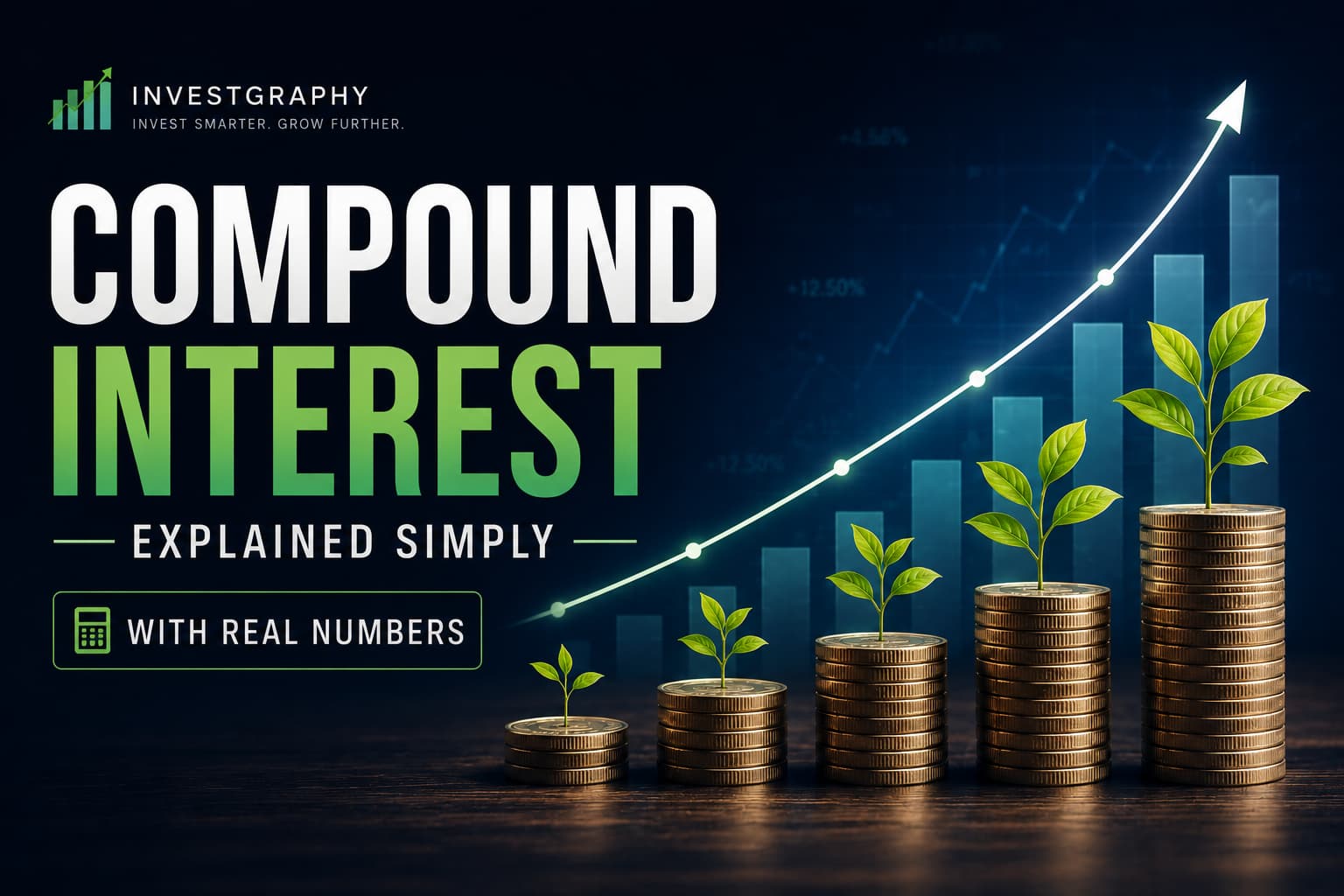
Now Reading: Compound Interest Explained Simply With Real Numbers
-
01
Compound Interest Explained Simply With Real Numbers

Last Updated: May 2026 · 5 min read · Investing Basics
Key Takeaways
- Compound interest means earning returns on both your original investment and on all the returns it has already generated
- A 25-year-old investing $200 a month at a 7% annual return can accumulate nearly $500,000 by age 65. A 35-year-old doing the exact same thing reaches only around $250,000
- $10,000 left to grow at a 6% average annual return for 30 years grows to more than $57,000, without adding another dollar
- Time matters more than the amount you start with: starting small and early consistently outperforms starting large and late
- Compound interest works the same way in reverse on debt, which is why high-interest debt grows so quickly if left unpaid
Compound interest means your money earns returns not just on what you originally invested, but on all the returns that investment has already generated. Each period, your gains get added back to your principal, and the next period’s returns are calculated on that larger amount. This creates a snowball effect, small at first, then accelerating significantly over time. The single biggest factor in how powerful that effect becomes is not how much you invest. It is how long you let it run.
The Difference Between Simple and Compound Interest
Simple interest calculates returns only on your original principal, every single period, no matter how long the money has been invested. If you invested $1,000 at 5% simple interest for five years, you would earn exactly $50 every year: $250 total, regardless of how long it sat there.
Compound interest works differently. After year one, your $1,000 at 5% grows to $1,050. In year two, the 5% return is calculated on $1,050, not the original $1,000, earning you $52.50 instead of $50. By year three, you are earning interest on $1,103.
This sounds like a small difference in the early years. It is not a small difference over decades.
A Real Example, Step by Step
Imagine you invest $1,000 at a 6% annual return and reinvest every gain.
In year one, you earn $60, bringing your total to $1,060. In year two, that same 6% return is calculated on $1,060 instead of $1,000, earning you $63.60 and bringing your total to $1,123.60. In year three, 6% of $1,123.60 is $67.42, bringing your total to $1,191.
Notice that your annual gain keeps growing ($60, then $63.60, then $67.42) even though the return rate never changed. That growth in your annual gain, without you adding a single additional dollar, is compound interest doing its work.
Left untouched for 30 years at that same 6% average return, $10,000 grows to more than $57,000. No new contributions. No change in strategy. Just time and reinvestment.
The Example That Changes How People Think About This
Here is the single most important illustration of compound interest for anyone starting their investing journey, especially if you feel like you are starting too late.
A 25-year-old who invests $200 every month at a 7% average annual return accumulates nearly $500,000 by age 65. A 35-year-old who invests that exact same $200 every month, at the exact same 7% return, reaches only around $250,000 by age 65.
Read that again. Both people invested the same amount every month. Both earned the same rate of return. The only difference was a 10-year head start, and that single decade was worth roughly $250,000 by retirement.
This is not because the 25-year-old invested more money overall. In fact, over those extra 10 years they contributed an additional $24,000 in total. The other roughly $226,000 of the gap came entirely from compounding having more time to work. Time is not just one factor in this equation. For most people, it is the single most powerful factor.
Why Reinvestment Is the Engine, Not the Return Rate
A common mistake beginners make is assuming the secret to compounding is finding a higher return rate. The return rate matters, but reinvestment is what actually makes compounding work.
If you earn a 6% return on an investment but withdraw the gains every year instead of reinvesting them, you are no longer compounding. You are earning simple interest on a fixed principal: your money grows in a straight line instead of a curve. The exponential part of compound interest only happens when your previous gains stay invested and start generating their own gains.
This is why dividend reinvestment plans, automatic contribution features, and simply leaving retirement accounts untouched matter so much. Every dollar you withdraw early is a dollar that stops compounding from that point forward, and in the simple example above, the version of you reinvesting every dollar ends up meaningfully ahead of the version withdrawing along the way.
How Often Interest Compounds Also Matters
Beyond time and reinvestment, the frequency of compounding makes a smaller but still real difference.
Interest can compound annually, monthly, or even daily, depending on the investment or account. The more frequently interest compounds, the slightly faster your money grows, because gains get added back to your principal more often, giving each new period a marginally larger base to calculate from.
For example, $5,000 invested at a 5% annual rate compounded monthly for 10 years grows to approximately $8,235, about $235 more in earned interest than the same investment would generate compounding only once per year. The difference is real but modest compared to the impact of time itself. A beginner should care about compounding frequency, but should care far more about how many years they let the investment run.
What This Means for AI Investing Specifically
Compound interest applies to any investment that generates returns and allows those returns to be reinvested, including AI stocks and ETFs.
If you invest in an ETF like QQQM and it pays dividends, reinvesting those dividends automatically (most brokerages offer this as a free feature) means your dividend income starts generating its own returns, compounding the same way the simple examples above demonstrate. Combined with price appreciation in the underlying companies, this is how a modest monthly contribution into a broad fund can grow substantially over a decade or more.
The lesson from the 25-versus-35 example applies directly here. A beginner who starts investing $100 a month into an AI ETF today, even with no further increases, has a structural advantage over someone who waits five years to start with a larger amount. Time in the market, not the size of your first contribution, is what compound interest rewards most.
The One Important Caveat
Every example in this article uses a fixed, assumed rate of return for simplicity. Real markets do not work that way.
Actual investment returns vary year to year, sometimes dramatically. A diversified portfolio might return 25% one year and lose 10% the next, averaging out to something like 6% to 7% over many decades, but the path there is never smooth. These examples are illustrative tools for understanding the mathematics of compounding, not predictions or guarantees of what any specific investment will actually return.
Compound interest also works in reverse. Credit card debt and other high-interest borrowing compound the same way, except the snowball effect works against you, growing your balance faster the longer it goes unpaid. Understanding compounding is just as useful for avoiding debt traps as it is for building wealth.
FAQ
What is compound interest in simple terms?
Compound interest means earning returns on both your original investment and on all the returns that investment has already accumulated. Each period, your gains are added back to your principal, so the next period’s return is calculated on a larger amount than before. This creates accelerating growth over time, often described as a snowball effect, which becomes significantly more powerful the longer the money stays invested.
Why does starting early matter so much for compound interest?
Time is the single most powerful factor in compound interest because each additional year gives your reinvested gains another full cycle to generate their own returns. A 25-year-old investing $200 monthly at 7% can accumulate nearly $500,000 by age 65, while someone starting the identical strategy 10 years later, at age 35, reaches only around $250,000, despite contributing nearly the same amount overall. The gap comes almost entirely from the extra decade of compounding time.
Does compound interest work the same way for stocks and ETFs as it does for savings accounts?
The underlying mathematical principle is the same: reinvested gains generate their own future gains. The key difference is that savings accounts typically offer a fixed, predictable interest rate, while stocks and ETFs generate variable returns through price appreciation and dividends that fluctuate year to year. Reinvesting dividends from a stock or ETF, rather than withdrawing them, allows the same compounding effect to apply to market investments.
How can a beginner take advantage of compound interest right now?
The most direct way is to start investing consistently as early as possible and to reinvest any dividends or returns rather than withdrawing them. Most brokerages offer automatic dividend reinvestment as a free feature. The amount you start with matters far less than how many years you allow the investment to compound; a smaller amount invested today has a structural advantage over a larger amount invested several years from now.
Compound interest is not a complicated concept once you see it laid out step by step. The math is simple. The impact, given enough time, is anything but.
The gap between a 25-year-old and a 35-year-old investing the exact same amount at the exact same return, roughly $250,000 by retirement, is the most convincing argument for starting now rather than waiting until you feel more ready. There is rarely a perfect time to start. There is only the time you actually begin, and the years of compounding you either capture or give away by waiting.
Want plain English investing breakdowns every week? Subscribe to the Investgraphy brief: free, five minutes, no hype.
This article is for educational and informational purposes only and does not constitute financial advice. All examples use hypothetical, fixed rates of return for illustrative purposes only and are not indicative of any specific investment or guaranteed future results. Real investment returns vary and involve risk, including possible loss of principal. Always conduct your own research and consult a qualified financial advisor before making investment decisions.
About the Author
Investgraphy Team: Independent AI investing education for self-directed beginners. No hype, no jargon, no financial advice.