
Now Reading: What Is an ETF and How Does It Work?
-
01
What Is an ETF and How Does It Work?

Last Updated: May 2026 · 6 min read · Investing Basics
Key Takeaways
- An ETF — exchange-traded fund — is a basket of investments that trades on a stock exchange like a single share
- Global ETF assets reached $19.5 trillion at the start of 2026, up from $14.6 trillion at the end of 2024 — a 33% annual growth rate
- The average ETF charges an expense ratio of around 0.16%, compared to 0.47% for the average actively managed mutual fund — roughly three times more expensive
- Unlike mutual funds, ETFs trade throughout the day at live market prices, just like an individual stock
- Over 6,000 ETFs trade in the US as of 2026, covering nearly every sector, region, and investment strategy — including dozens focused specifically on AI
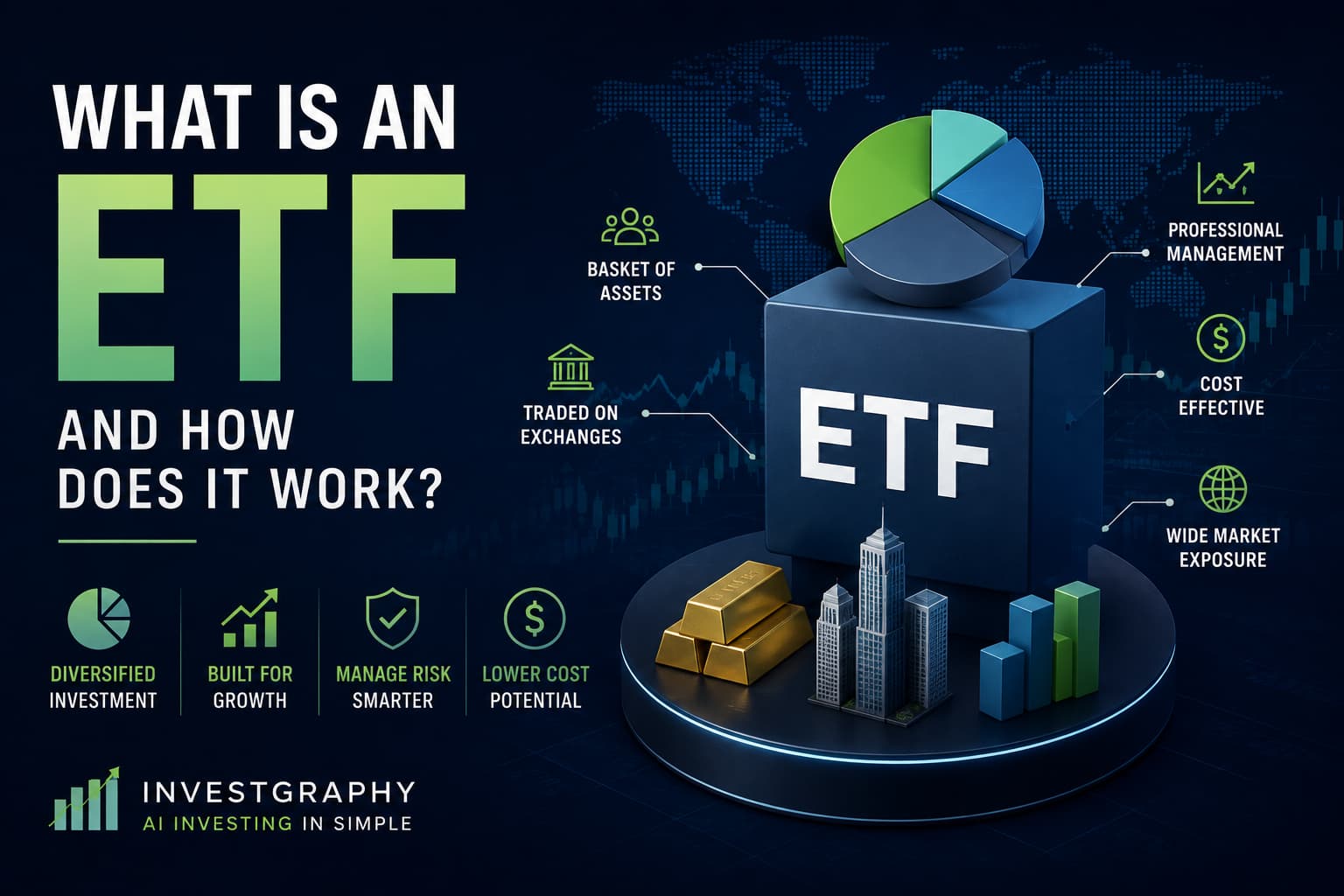
An ETF, or exchange-traded fund, is a basket of investments — stocks, bonds, or other assets — that trades on a stock exchange like a single share. When you buy one share of an ETF, you are buying a small proportional piece of everything that fund holds. ETFs combine the diversification of a mutual fund with the convenience of buying and selling a stock. Global ETF assets reached $19.5 trillion at the start of 2026, and the average ETF charges roughly a third of what a typical actively managed mutual fund costs.
The Basic Mechanics of an ETF
An ETF is created by a fund company — Vanguard, Invesco, BlackRock, and Global X are common examples — which assembles a basket of underlying securities according to a specific strategy. That strategy might be tracking an index like the NASDAQ 100, focusing on a sector like semiconductors, or targeting a theme like robotics and AI.
The fund company then issues shares representing ownership in that basket, and those shares list on a stock exchange under a ticker symbol — just like an individual company’s stock. QQQM, BOTZ, and AIQ are all examples of ETF tickers.
When you place an order to buy QQQM through your brokerage account, you are not buying shares of any single company directly. You are buying a share of the fund itself, which in turn holds shares of all 102 companies in the NASDAQ 100, including NVIDIA, Microsoft, and Apple. Your $100 investment effectively gets divided across all of those companies in proportion to how much of each the fund holds.
Why ETFs Trade Differently Than Mutual Funds
The single biggest practical difference between an ETF and a traditional mutual fund is when and how you can trade it.
A mutual fund is priced once per day, after the market closes. If you place an order to buy a mutual fund at 10am, your trade executes at whatever the fund’s closing price turns out to be at the end of that trading day — you do not know the exact price when you place the order.
An ETF trades continuously throughout the day, just like a stock. Its price moves in real time based on supply, demand, and the value of its underlying holdings. You can see the exact price before you buy, place a limit order at a specific price, or sell instantly if you change your mind — none of which is possible with a traditional mutual fund.
This structural difference is also a major reason ETFs tend to be more tax-efficient than mutual funds, due to how shares are created and redeemed behind the scenes. For most beginners, the practical takeaway is simpler: ETFs behave like stocks you can buy and sell anytime the market is open.
Why ETFs Cost So Much Less
Cost is one of the clearest, most measurable advantages ETFs have over actively managed mutual funds.
The average ETF charges an expense ratio of around 0.16% — meaning roughly $1.60 per year for every $1,000 invested. The average actively managed mutual fund charges about 0.47%, nearly three times as much. Some of the largest index ETFs, including funds tracking the S&P 500, charge as little as 0.03%.
The reason for this gap is structural. Most ETFs are passively managed — they simply track an index mechanically rather than paying a team of analysts and portfolio managers to actively pick investments. Fewer people involved in day-to-day decision-making means lower operating costs, which get passed on to investors as lower fees.
This cost difference compounds significantly over long time horizons. An investor paying 0.16% annually keeps meaningfully more of their returns over 20 or 30 years than one paying 0.47% on a comparable investment, even if the underlying performance is similar.
The Diversification Benefit in Practice
Buying individual stocks means your outcome depends heavily on a small number of companies performing well. If one of those companies has a bad year, your entire portfolio feels it.
An ETF can hold dozens, hundreds, or even thousands of underlying securities in a single trade. If one company inside the fund disappoints, the rest of the basket cushions the impact. This is the core reason most financial educators recommend ETFs as a starting point for beginners rather than individual stock picking — one purchase gives you diversification that would otherwise require dozens of separate transactions and ongoing research.
This matters specifically for AI investing. Trying to predict which single AI company will perform best over the next decade is genuinely difficult — the field is moving quickly and competitive dynamics can shift fast. A fund like QQQM or AIQ spreads that uncertainty across many companies at once, rather than concentrating it in one bet.
How Fast the ETF Industry Is Actually Growing
The scale of the ETF industry helps explain why it has become the default vehicle for most retail investors building long-term portfolios.
Global ETF assets reached $19.5 trillion at the start of 2026, up from $14.6 trillion at the end of 2024 — a 33% annual growth rate. Record global net inflows of $2.1 trillion poured into ETFs in 2025 alone, nearly three and a half times what flowed into mutual funds during the same period. More than a third of industry executives surveyed by PwC expect global ETF assets to reach $35 trillion or higher by 2030.
A newer trend worth understanding is the rise of actively managed ETFs. Traditionally, ETFs were almost entirely passive — simply tracking an index. That has changed quickly: active ETFs held nearly $1.8 trillion in assets by the end of 2025, growing at a 53% organic rate that year. CHAT, the actively managed generative AI ETF, is one example of this broader shift — combining a portfolio manager’s stock selection with the trading flexibility of the ETF structure.
What Beginners Should Actually Do With This
Understanding what an ETF is matters less than understanding what to do with that knowledge.
For most beginners, a broad, low-cost ETF is the most practical first investment — it removes the pressure of picking individual winners while still providing real exposure to the sectors and themes you care about, including AI. Opening a brokerage account, depositing money, and buying a single ETF takes less time than reading this article.
The decision that actually matters is not which specific ETF has the best ticker or the cleverest name — it is whether the fund’s cost, diversification, and underlying holdings match what you are trying to achieve. A 0.15% expense ratio fund holding 100 established companies serves a very different purpose than a 0.75% actively managed fund concentrated in a narrow theme. Both are legitimate ETFs. They are not interchangeable.
FAQ
What is the difference between an ETF and a stock?
A stock represents ownership in a single company. An ETF represents ownership in a basket of many underlying securities — which could be dozens, hundreds, or thousands of stocks, bonds, or other assets — packaged into one tradable share. Both trade on stock exchanges throughout the day at live market prices, but buying one ETF share gives you diversified exposure that buying one stock share does not.
What is the difference between an ETF and a mutual fund?
ETFs trade continuously throughout the day at live market prices, just like a stock. Mutual funds are priced only once per day after the market closes, meaning you do not know your exact execution price when you place an order. ETFs also tend to charge lower fees — the average ETF expense ratio is around 0.16% versus 0.47% for the average actively managed mutual fund — and are generally more tax-efficient due to differences in how shares are created and redeemed.
Are ETFs safe for beginners?
ETFs carry the same market risk as any equity investment — their value can go up or down, and you can lose money. What makes them comparatively lower-risk than picking individual stocks is diversification: a single ETF can hold dozens or hundreds of companies, so the failure of any one holding has a limited impact on your total investment. ETFs are not risk-free, but their structure is generally considered more beginner-friendly than concentrated individual stock picking. This is not financial advice — always research before investing.
How do I buy my first ETF?
You need a brokerage account — Fidelity, Charles Schwab, and Vanguard are common examples, and most offer commission-free ETF trading with no account minimum. Once your account is funded, you search for the ETF’s ticker symbol, enter the dollar amount or number of shares you want, and place the order. Fractional share features at many brokerages mean you can buy a partial share of an ETF with as little as $1, so you do not need a large amount of money to begin.
An ETF is simply a basket of investments wrapped into a single tradable share — nothing more complicated than that. The reason they have grown into a $19.5 trillion global industry is that they solve a real problem: getting diversified exposure to a sector, theme, or entire market without needing to research and buy dozens of individual companies yourself.
For a beginner building exposure to AI investing, ETFs remove the hardest decision — picking the single best company — and replace it with a simpler one: which fund’s cost and holdings best match what you are trying to own.
Want plain English investing breakdowns every week? Subscribe to the Investgraphy brief — free, five minutes, no hype.
This article is for educational and informational purposes only and does not constitute financial advice. All figures are sourced from LSEG Global ETF Industry Review, PwC’s ETF 2030 survey, ETF.com, and State Street as of May 2026. ETF data including AUM, flows, and expense ratios change frequently — always verify current figures before making investment decisions. Investing involves risk including possible loss of principal. Always conduct your own research and consult a qualified financial advisor.
About the Author
Investgraphy Team — Independent AI investing education for self-directed beginners. No hype, no jargon, no financial advice.