
Now Reading: Why The Crowd Always Buys the Headline Too Late
-
01
Why The Crowd Always Buys the Headline Too Late

Last Updated: May 2026 · 5 min read · Investor Mindset
Key Takeaways
- Institutional investors captured the most significant gains in AI chip stocks before retail investors noticed — a pattern repeated in every major tech rally
- Retail investor activity in 2025 was 50% higher than 2024, surpassing even the 2021 meme-stock era — with most of it concentrated in AI stocks already near peak valuations
- Heavy retail buying at the end of a steep rally is historically viewed as a contrarian signal — not a green light
- The solution is not better timing — it is understanding which part of the cycle you are in before you buy
By the time an AI stock appears in mainstream headlines, institutional investors have usually already built their positions. Retail investors then buy based on momentum and fear of missing out — often entering near the top of the rally. This pattern has repeated in every major technology boom. Understanding it does not require advanced finance knowledge. It just requires knowing how the sequence works.
The Sequence Nobody Explains to Beginners
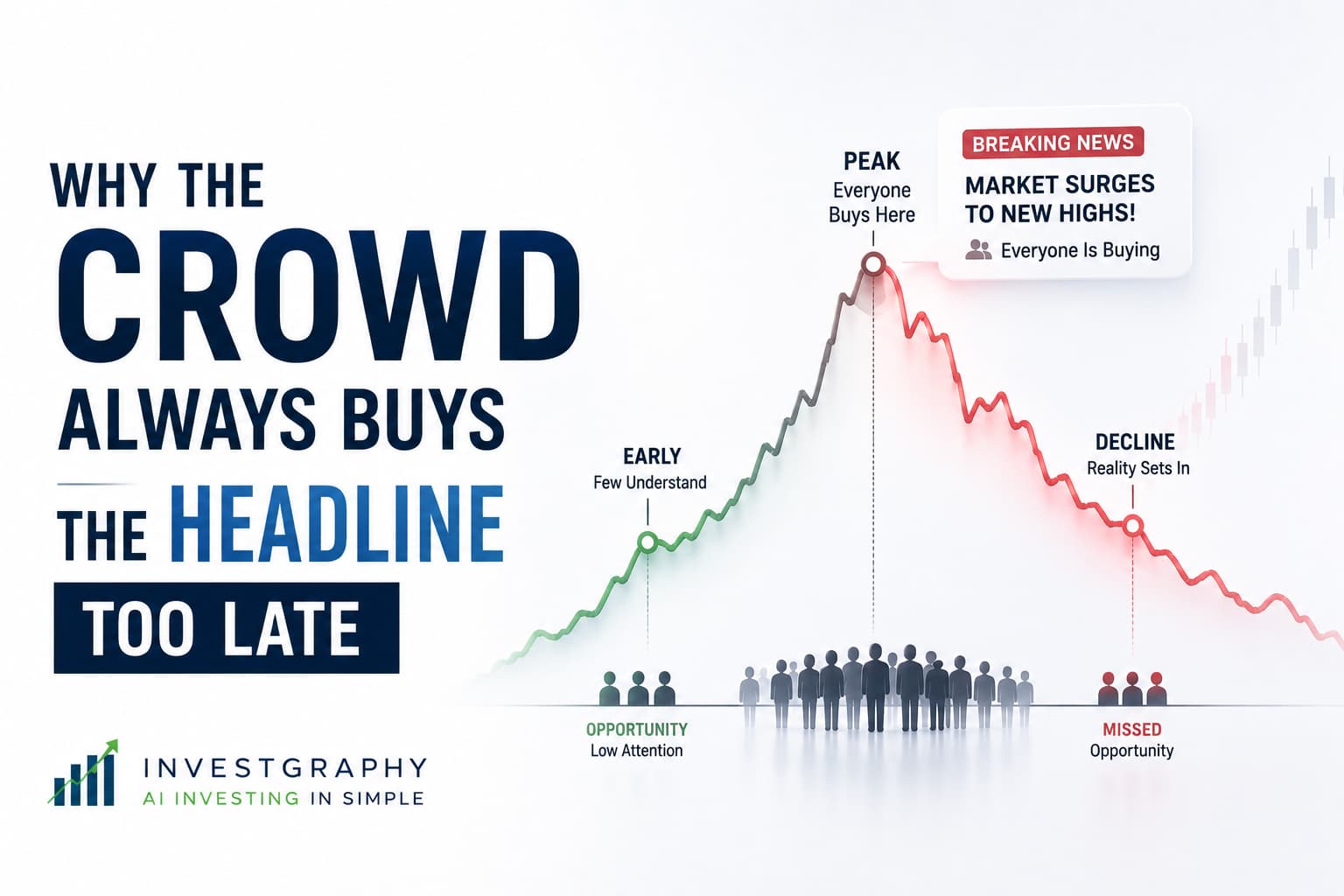
Every major market rally follows roughly the same sequence. It does not happen on a fixed timeline, but the order is almost always the same.
First, institutional investors — hedge funds, pension funds, sovereign wealth funds — identify the opportunity and begin building positions quietly. Prices rise, but slowly. There is little media coverage. Most retail investors are not paying attention.
Then the rally accelerates. Prices rise faster. Financial media starts covering it. The story becomes simple enough to explain in a headline. This is where FOMO begins.
Finally, retail investors pile in. Volume surges. Prices often reach their highest point. Then institutions — who have been sitting on significant gains — begin selling into that retail liquidity.
This is not a conspiracy. It is just how markets work. And it played out clearly in AI stocks throughout 2024 and 2025.
What Happened With AI Stocks
During the early AI chip rally, institutional investors drove the advance in semiconductor stocks for months before retail participation meaningfully increased. By the time the rally became front-page news, those institutions had already locked in significant positions — and valuations had reached historic highs.
Retail investors then entered based on momentum. In 2025, retail investor activity was roughly 50% higher than in 2024 — surpassing even the 2021 meme-stock frenzy. Cash poured into stocks was up 53% year over year. Most of that capital concentrated into a narrow group of 30 AI and technology stocks.
The problem with concentration at that stage is straightforward. If everyone who wants to buy has already bought, there are fewer buyers left to push prices higher. When retail investors provide the final surge of liquidity, institutions often use that liquidity to reduce their own positions.
Why Headlines Are a Lagging Indicator
A financial headline is not a signal to buy. It is a record of what has already happened.
By the time a stock becomes famous enough to appear in mainstream media — NVIDIA in 2023, AI infrastructure in 2024, energy stocks tied to data centers in 2025 — the people who made the most money on that trade were already in it. Sometimes by years.
A Deutsche Bank survey in late 2025 found that 57% of investors viewed a potential crash in AI valuations as the single greatest risk to market stability going into 2026. That level of mainstream concern about a bubble typically appears after, not before, the period of maximum risk.
This does not mean AI stocks will crash. It means that buying based on headlines alone — without understanding what you are buying or where it sits in its cycle — is how most retail investors end up holding an asset they paid too much for.
The Pattern Is Not New
This dynamic is not specific to AI. It has appeared in every major technology cycle in modern investing history.
Internet stocks in the late 1990s attracted enormous retail participation in 1999 and early 2000 — the final stage of a rally that had been running for years. The investors who made generational wealth were the ones who had been in since 1995 or 1996.
Cryptocurrency followed the same pattern in 2017 and again in 2021. The retail surge came at the end, not the beginning.
The current AI cycle is different in one important way: the underlying infrastructure demand is real, measurable, and backed by hundreds of billions in signed corporate contracts. This is not the dot-com era, where many companies had no revenue. But the psychological pattern — retail buying the headline, institutions selling into that buying — operates regardless of whether the underlying business case is real.
What You Can Do Instead
The answer is not to try to time the market. Professional traders with teams of analysts and decades of experience routinely fail at market timing. A beginner investor is not going to out-time an institution.
The answer is to change what you are trying to do entirely. Instead of asking “is now a good time to buy this AI stock,” ask three different questions:
Do I understand what this company actually does and why it makes money? Not the headline — the actual business model.
Am I buying because I understand it, or because I am afraid of missing out? Those are very different decisions with very different outcomes.
Can I hold this for five to ten years regardless of what happens in the next six months? Short time horizons combined with FOMO entries are how most retail investors end up selling at a loss.
The investors who historically build wealth in technology cycles are not the ones who caught the top of the rally. They are the ones who bought something they understood, at a price that made sense, and held it through the volatility that followed.
FAQ
Why do retail investors always seem to buy at the top?
Retail investors typically enter based on momentum and social proof — buying after weeks of positive headlines and price increases create fear of missing out. By that stage, institutional investors have often already built large positions during the quieter early phase of the rally. This is a structural timing gap that repeats across every major technology cycle, not a failure unique to any individual investor.
Is FOMO always a bad reason to buy a stock?
FOMO is not a reason to buy or avoid anything — it is an emotion, not an analysis. The problem is when FOMO replaces analysis entirely. Buying a stock because you understand the business, see a reasonable valuation, and have a long holding period is sound. Buying because the price went up and you are afraid of missing out is how most retail investors end up entering near a top.
How can a beginner know where they are in a market cycle?
No one can identify a cycle peak in real time with certainty — including professional investors. What beginners can do is look at how much media coverage a stock is receiving, how fast prices have already risen, and whether the valuation reflects realistic future earnings or speculation. A stock that has already tripled in 18 months requires significantly more growth to justify its price than one that has not yet moved.
What is the alternative to trying to time AI stocks?
Broad index funds and ETFs that include AI infrastructure exposure allow beginners to participate in the long-term theme without trying to pick individual entry points. Dollar-cost averaging — investing a fixed amount at regular intervals regardless of price — removes the timing decision entirely. These are not exciting strategies. They are historically more effective for most retail investors than attempting to time individual stock purchases based on headlines.
Conclusion
The crowd is not wrong about AI. The technology is real, the infrastructure buildout is real, and the long-term investment case is backed by hundreds of billions in committed capital.
The crowd is just consistently late. And in investing, being late to a trade is often as costly as being wrong about it.
Understanding the sequence — how rallies build, who participates first, and what heavy retail buying historically signals — does not make you a better stock picker. It makes you a more honest one.
Want this kind of thinking every week? Subscribe to the Investgraphy brief — plain English, five minutes, no hype.
Disclaimer
This article is for educational and informational purposes only and does not constitute financial advice. All figures cited are sourced from publicly available reports including Deutsche Bank, Bloomberg, and Ainvest market analysis. Investing involves risk including possible loss of principal. Past market patterns do not guarantee future results. Always conduct your own research and consult a qualified financial advisor before making investment decisions.
About the Author
Investgraphy Team — Independent AI investing education for self-directed beginners. No hype, no jargon, no financial advice.