
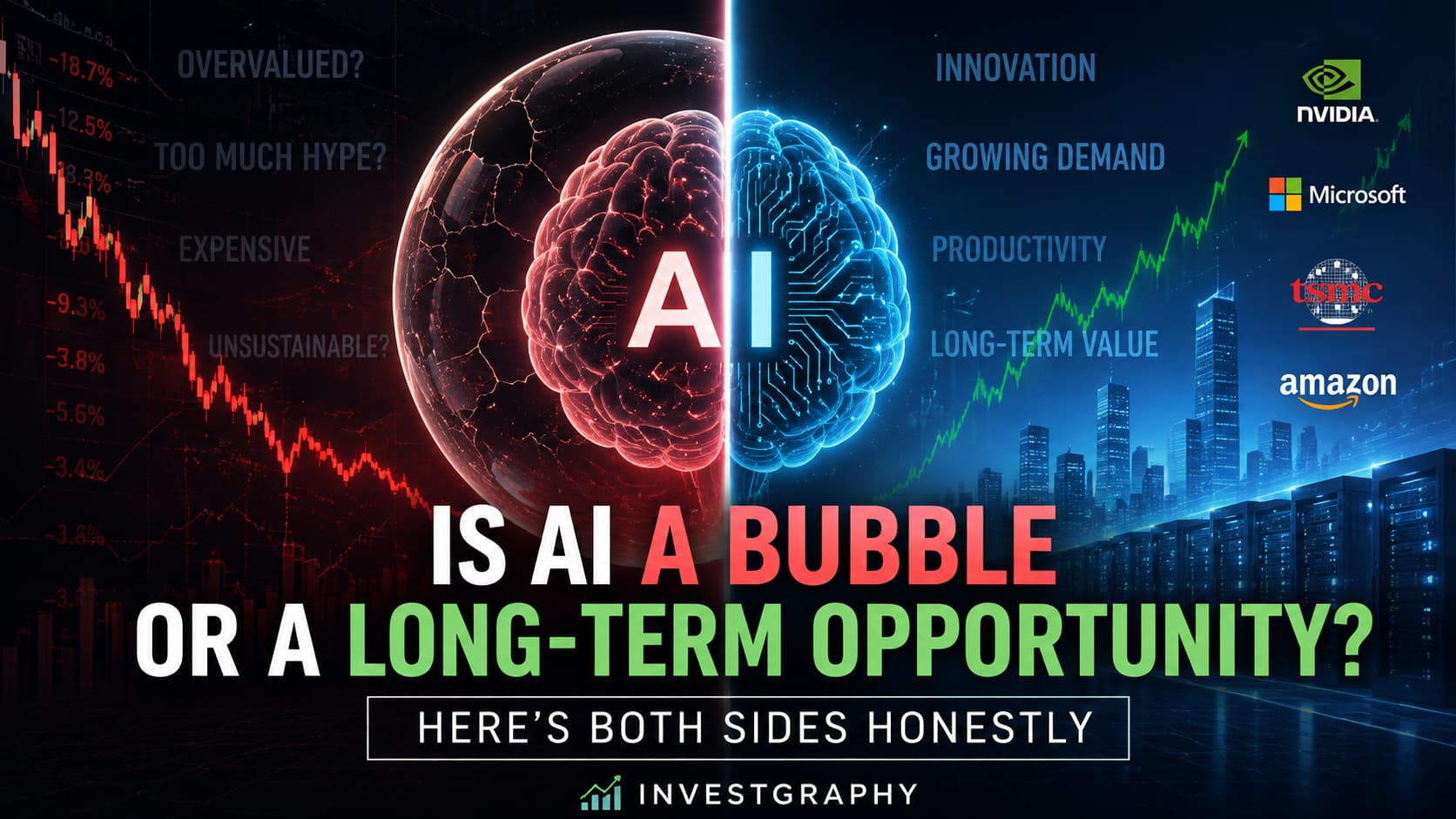
Now Reading: Is AI a Bubble Or a Long-Term Opportunity? Here’s Both Sides Honestly
-
01
Is AI a Bubble Or a Long-Term Opportunity? Here’s Both Sides Honestly
- Home
- Investor Mindset
- Is AI a Bubble Or a Long-Term Opportunity? Here’s Both Sides Honestly
Is AI a Bubble Or a Long-Term Opportunity? Here’s Both Sides Honestly

Last Updated: May 2026 · 7 min read · Investor Mindset
- 40% of fund managers currently consider AI stocks a bubble, but Fidelity, as of early 2026, identifies none of the classic warning signs of a speculative crash.
- The five largest hyperscalers are spending $755 billion on AI capital expenditure in 2026, but enterprise AI revenue currently stands at roughly $100 billion, creating a significant spending-to-revenue gap.
- Unlike the dot-com era, today's leading AI companies generate real and substantial profits: NVIDIA alone produced $215.94 billion in fiscal year 2026 revenue, up 65% year over year.
- Morningstar's chief equity strategist said in May 2026 that AI fundamentals remain solid, with none of the warning signs of a bubble about to burst.
- The honest answer is that both sides have legitimate data, and a beginner investor's best response is understanding the risk without letting either fear or optimism make the decision for them.
Whether AI is a bubble depends on which part of the AI market you are examining. The leading AI infrastructure companies, NVIDIA, TSMC, Microsoft, and Amazon, are generating real, growing, and substantial revenue backed by signed multi-year contracts. That is not bubble behavior. Valuations on some of those same companies, however, already price in years of continued extraordinary growth, and if that growth slows, the prices would need to adjust. Both statements are true simultaneously. Understanding the difference between the AI opportunity and the AI valuation is the most useful distinction a beginner investor can develop.
The Case That AI Is Overvalued
The concerns about AI valuations are real and deserve to be taken seriously rather than dismissed.
The five largest hyperscalers, Alphabet, Amazon, Meta, Microsoft, and Oracle, are projected to spend approximately $755 billion on AI-related capital expenditure in 2026. Enterprise AI revenue, the money businesses are actually generating back from their AI deployments, currently stands at roughly $100 billion. That gap between what is being spent and what is currently being earned is real, and it is wide.
This spending-to-revenue mismatch is one of the central arguments made by bubble skeptics. Hyperscalers are investing at a pace that assumes AI will generate transformative economic returns across virtually every industry within a few years. If those returns are delayed, or prove smaller than projected, the capital expenditure programs that are currently driving NVIDIA's revenue growth could slow materially.
Valuation multiples have also expanded significantly. The S&P 500 was trading at approximately 23 times forward earnings in 2026, and individual AI infrastructure stocks command premiums well above that average, pricing in years of flawless execution.
There is also a pattern comparison that bubble skeptics make to the late 1990s. The NASDAQ Composite's surge then also had a genuine technological foundation: the internet was real, and its long-term impact proved transformative. But the speed of capital deployment and the extreme valuations attached to companies still years away from sustainable profitability caused a crash that took over a decade to fully recover from. The question is not whether AI is real. It is whether the current pricing already reflects everything good that could happen.
The Case That AI Is a Structural Long-Term Opportunity
The counter-argument is not simply optimism. It is grounded in data that looks meaningfully different from previous speculative cycles.
Fidelity, analyzing the AI investment landscape as of early 2026, found none of the classic warning signs that typically precede a speculative crash: no shrinking free cash flows among the leading AI companies despite aggressive infrastructure spending, no deteriorating leverage ratios, no compression of price-earnings multiples caused by fundamental growth constraints. The signs they were watching for were absent.
"The underlying fundamentals are very solid."
Michael Field, Chief Equity Strategist, Morningstar, May 2026Morningstar's research found that the AI theme sector valuation discount was at its largest since 2019, meaning relative to historical averages, some AI infrastructure stocks were trading at more reasonable valuations than at any point in the past seven years.
The most important distinction from the dot-com era is profitability. The internet companies that crashed in 2000 were largely pre-revenue or pre-profit. Their valuations were based entirely on future potential. Today's leading AI companies are different in kind. NVIDIA alone generated $215.94 billion in revenue in fiscal year 2026, up 65% year over year, with gross margins between 79% and 88%. Microsoft, Alphabet, and Amazon are all highly profitable businesses with AI as an accelerating component of existing revenue streams, not speculative startups with no earnings.
The Real Distinction: Infrastructure vs. Applications
One of the most useful frameworks for thinking about this question comes from separating the AI investment landscape into two distinct categories that carry different risk profiles.
← Scroll to see full table →| Layer | Examples | Risk Profile | Key Risk |
|---|---|---|---|
| AI Infrastructure | NVIDIA, TSMC, Vertiv, Constellation Energy, major cloud providers | Real revenue, real customers, multi-year contracts | Valuation: prices may already reflect all good news |
| AI Applications | Consumer AI tools, SaaS with "AI features", pre-revenue AI startups | More speculative, intense competition, limited pricing power | Displacement: next product may do the same for less |
AI infrastructure companies have real revenue, real customers, and contracts that lock in revenue years into the future. The risk here is not whether the demand is real. The risk is valuation: whether the current stock prices already reflect all the good news, leaving limited upside if growth merely meets expectations rather than exceeding them.
A beginner investor who understands this distinction can ask a much more useful question than "is AI a bubble?" They can ask: which layer of the AI stack is this specific investment in, and what would need to happen for that investment to underperform?
What History Actually Says About Technology Investment Cycles
The dot-com comparison is worth examining carefully because it is the most commonly invoked historical parallel, and the lesson most people draw from it is partially wrong.
The NASDAQ Composite fell approximately 78% from its 2000 peak to its 2002 trough. It did not fully recover to its pre-crash peak until 2015, fifteen years later. For investors who bought at the peak in March 2000, the experience was genuinely devastating over any reasonable time horizon.
Investors who began dollar-cost averaging into broad technology funds during the 2000 to 2002 crash, and held consistently through the recovery, captured some of the strongest long-term returns in modern investing history. The internet itself was never a bubble. Speculative internet company valuations were.
The investors who lost everything had concentrated their portfolios in individual companies with no revenue and no path to profitability. The investors who held diversified technology exposure through the crash and recovery did extremely well over the subsequent decade.
The current AI cycle has real revenue, real profits, and real infrastructure demand. That does not make any individual AI stock reasonably valued at any given price. It does mean that a diversified, long-horizon investor in AI is not in the same position as someone who put their savings into Pets.com in 1999.
How a Beginner Should Actually Think About This
The most honest answer to "is AI a bubble" is that the question is not binary, and the right response for a beginner investor is not to place a bet on either answer.
Three practical principles follow from the analysis above:
Understand the distinction between the opportunity and the valuation.
AI as a technology and investment theme has substantial real-world foundations. Individual AI stocks at specific prices may or may not offer good value at any given moment. Those are separate questions.
Diversification does not solve a bubble, but it does limit the damage.
In 2000, concentrated individual stock pickers got destroyed. Diversified index fund holders recovered within a decade. If AI valuations correct significantly, the investor holding a broad fund that includes AI as a component will be in a better position than someone concentrated in a single AI stock.
A correction is not the same as a collapse.
Even if AI stocks experience a significant pullback from current levels, that would not necessarily mean the underlying investment thesis was wrong. It would mean prices had gotten ahead of fundamentals temporarily, as they have done in every technology cycle in history, before resuming a long-term upward trajectory tied to real business performance.
Frequently Asked Questions
Q Is AI investing in 2026 like the dot-com bubble?
There are surface-level similarities: rapid capital deployment, elevated valuations, and narrative-driven enthusiasm. The fundamental difference is profitability. The internet companies that crashed in 2000 were mostly pre-revenue or pre-profit. Today's leading AI companies including NVIDIA, Microsoft, Alphabet, and Amazon are generating substantial and growing profits. NVIDIA alone produced $215.94 billion in fiscal year 2026 revenue. This does not mean individual AI stocks cannot decline significantly. It means the comparison to 2000 has real limits.
Q What would cause an AI market crash?
The most commonly cited risks are a significant slowdown in hyperscaler capital expenditure (if Amazon, Microsoft, or Google cut AI infrastructure spending, NVIDIA's revenue growth would slow materially) and failure of enterprise AI deployments to generate sufficient returns on investment, which would cause companies to reduce future AI spending. Geopolitical escalation affecting semiconductor supply chains, particularly involving Taiwan, is a third risk. None of these are certain to materialize, but all are being actively monitored by institutional investors.
Q What do analysts say about AI valuations in 2026?
Analyst views are genuinely divided. Forty percent of fund managers in recent surveys consider AI stocks a bubble. Morningstar's chief equity strategist said in May 2026 that AI fundamentals remain solid and that the sector is not showing signs of a bubble about to burst. Fidelity found none of the classic bubble warning signs in its early 2026 analysis. Deutsche Bank found that 57% of investors view an AI valuation correction as the single greatest market risk. Presenting any single analyst view as the consensus would be inaccurate. The debate is real and ongoing.
Q Should a beginner avoid AI investing because of bubble concerns?
Not necessarily, but bubble concerns should inform how you invest rather than whether you invest. Holding diversified AI exposure through broad funds rather than concentrated individual positions, maintaining a long time horizon of at least five to ten years, and avoiding buying based purely on price momentum are all practical adjustments that reduce the risk of a valuation correction without requiring you to predict one accurately. The investors most damaged by the dot-com crash were concentrated in individual speculative stocks, not those holding diversified technology funds. This is not financial advice; always consult a financial advisor.
The AI bubble debate will not be resolved by any article, analyst, or fund manager before it becomes clear in hindsight. The honest answer in May 2026 is that the underlying infrastructure demand is real, the leading companies are profitable, and the valuations on some of those companies already price in years of continued extraordinary performance.
Both of those things are true. They are not contradictory. They just require a more nuanced response than either "AI is definitely a bubble" or "AI will definitely keep going up."
For a beginner investor, the most useful takeaway is the same one that applies to every investment decision: understand what you own, diversify appropriately, invest for a time horizon long enough to survive short-term volatility, and do not let either fear or optimism make decisions that should be based on analysis.
Want clear, balanced AI investing analysis every week? Subscribe to the Investgraphy brief: free, five minutes, no hype.
This article is for educational and informational purposes only and does not constitute financial advice. All figures and analyst views are sourced from Fidelity, Morningstar, Deutsche Bank, Intellectia AI, and The Hill as of May to June 2026. Analyst opinions cited represent the views of the named analysts and firms and do not constitute endorsement or investment advice. Investing involves risk including possible loss of principal. Past market behavior does not guarantee future results. Always conduct your own research and consult a qualified financial advisor before making investment decisions.